
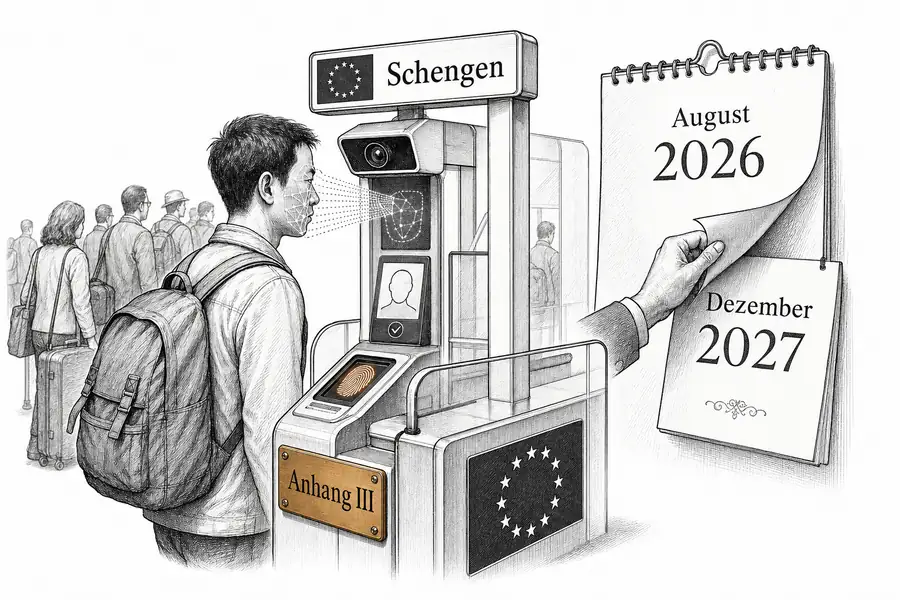
Deferred, not stopped: Annex III, border biometrics, and the Swiss provider
On 7 May 2026, the Council and Parliament reached a provisional agreement under the Digital Omnibus to defer the Annex III high-risk obligations of the AI Act from 2 August 2026 to 2 December 2027. For Swiss providers of biometric border systems, the calendar shifts — but not the jurisdictional reach under Art. 2 — and until formal adoption, August remains the operative date.
Dr. iur. Servatius von Tatzenberg
On 7 May 2026, the Council and Parliament reached a provisional agreement under the Digital Omnibus to defer the high-risk obligations of the AI Act (Regulation (EU) 2024/1689). What was due to apply from 2 August 2026 under Art. 113 is now set to take effect on 2 December 2027. That covers Annex III — and with it the biometric identification systems that have been operating at all Schengen external borders since 10 April 2026. Swiss providers bringing such systems to the EU market gain sixteen months. The obligations themselves remain unchanged.
Annex III lists two relevant high-risk applications: remote biometric identification under item 1, and government identification of persons in border and migration management under item 7. The EU’s Entry/Exit System has been collecting fingerprints and facial images of third-country nationals at every external border since 10 April. A system of that kind falls squarely under both items.
For the Swiss provider, location is irrelevant. Art. 2(1)(a) covers anyone who places an AI system on the market in the Union, whether established there or not; point (c) applies whenever the output is used within the Union. The obligation follows the product, not the postal address. A provider established outside the Union must also, under Art. 22, appoint in writing an authorised representative established in the Union before placing the product on the Union market.
The provider of a high-risk system must complete the conformity assessment procedure under Art. 43, maintain automatic logging under Art. 12, and demonstrate human oversight under Art. 14. Where a product falls exclusively under Annex III item 7, the internal conformity assessment under Art. 43(2) suffices; where item 1 also applies, Art. 43(1) requires involvement of the market surveillance authority acting as the notified body. Breaches of these obligations carry fines under Art. 99(4) of up to €15 million or 3 per cent of global annual turnover, whichever is higher. Harmonised standards for the conformity assessment have yet to be published.
The transitional date of 31 December 2030 under Art. 111(1) applies exclusively to components of the large-scale EU information systems listed in Annex X of the AI Act — including the Entry/Exit System, VIS, and Eurodac — provided they were placed in service before 2 August 2027. A standalone biometric product that a Swiss provider brings to market fresh does not qualify. The standard deadline applies.
The 7 May agreement is a political understanding, not yet binding law. Until Parliament and Council give their formal assent, the Regulation reads 2 August 2026. Appoint your Art. 22 authorised representative now and begin the conformity assessment: both require lead time that no extension delivers. The date to put in your calendar is the formal adoption of the Digital Omnibus by Parliament and Council. Until then, August stands.