
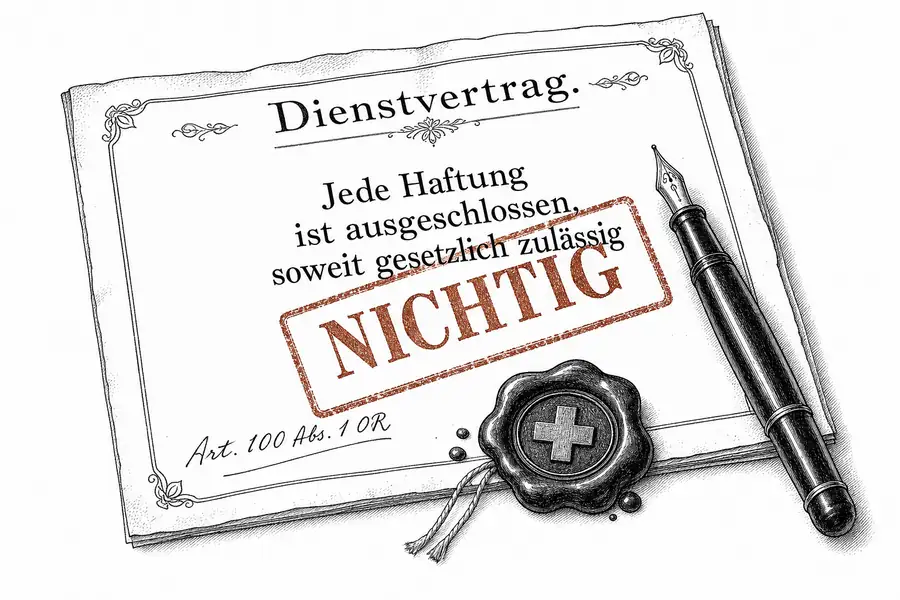
Exclusion or Cap: Where Art. 100(1) OR Voids the Blanket Liability Waiver
The blanket 'liability excluded' clause is void under Art. 100(1) OR precisely where the damage is largest — in cases of gross negligence and wilful misconduct. A party that drafts a full exclusion rather than a defined cap forfeits in standard terms even the protection the law would otherwise permit.
Casimir von Firn, MLaw
“Any liability is excluded to the extent permitted by law.” The sentence appears in almost every service contract, in the standard terms of every software licence, and in the warranty provisions of many share purchase agreements. Where it counts, it covers nothing. Art. 100(1) OR declares void any advance agreement purporting to exclude liability for wilful misconduct or gross negligence — and those are precisely the cases in which the loss is large enough to move a balance sheet.
The clause thus protects against what rarely costs much and fails precisely when catastrophe strikes. A party that drafts it as a blanket exclusion also forfeits the protection a defined cap would have retained. Exclusion and cap are not the same thing, and the difference turns on Art. 100 and 101 OR.
What the Clause Covers — and What It Does Not
Art. 100(1) OR is mandatory law. The parties cannot contract out of it, however carefully they draft. A maximum-sum limitation changes nothing in this regard under prevailing scholarly opinion: a sum cap is treated as a partial exclusion, and a partial exclusion cannot limit liability for loss caused by gross negligence any more than a full one can. A minority view holds that a commercially reasonable cap does not constitute an exclusion within the meaning of Art. 100(1) OR; the Federal Supreme Court (Bundesgericht) has not yet definitively resolved the point for pure cap limitations (see Atamer/Küng, Haftungsbegrenzung beim Kauf).
Nullity arises by operation of law — the clause is automatically void for cases of gross negligence and wilful misconduct, without any need for the counterparty to raise an objection. What the claimant must prove is the degree of fault: breach of contract and loss alone do not trigger Art. 100; only proof of gross negligence or wilful misconduct strips the clause of its force. That proof is demanding. This is precisely why the clause holds in the ordinary case of mild negligence and fails in the exceptional case that costs the money.
A numerical example from a standard M&A structure: purchase price CHF 50 million, warranty liability capped at ten per cent, i.e. CHF 5 million. If the seller conceals a dispute it knew about and the resulting loss amounts to CHF 18 million, the cap is overridden by Art. 199 OR and Art. 100(1) OR. The buyer recovers the full CHF 18 million. The threshold matters: in a sale, only fraudulent concealment breaks the exemption — that is, positive knowledge of the defect, not merely grossly negligent ignorance of it (Walder Wyss).
Own Fault, Third-Party Fault
Here begins the asymmetry that most clauses overlook. For the conduct of auxiliaries — employees, subcontractors, agents — Art. 101(2) OR is generous: their liability may be excluded in advance even for gross negligence (Rusch/Bornhauser, AJP). For a party’s own fault that freedom does not exist.
“Own” reaches further than the clause typically assumes. The conduct of corporate bodies — the board of directors, executive management — is attributed to the legal entity as its own under Art. 55(2) ZGB. It falls under Art. 100, never under Art. 101. The gross negligence of a warehousing contractor can be excluded; that of executive management cannot. A party that lumps both into a single blanket exclusion forfeits the freedom available under Art. 101(2) OR while simultaneously overstepping the mandatory limit of Art. 100(1) OR.
The Licensed-Business Special Case
For regulated counterparties the room narrows further. Where the party waiving liability is in the other party’s service, or where the responsibility arises “from the operation of a government-licensed business” (Art. 101(3) OR), liability for auxiliaries may be excluded at most for mild negligence. Art. 100(2) OR further empowers the court to declare void even an exclusion for mild negligence.
Whether a licensed bank operates such a government-licensed business was left open by the Bundesgericht. In BGE 109 II 116, C., a member and secretary of the board of directors of the claimant company, had withdrawn CHF 20,600 from the company account using forged receipts between October 1978 and January 1979. Because the Bundesgericht attributed his conduct to the company as its own under Art. 55(2) ZGB, the company brought a damages claim against the bank — and the bank invoked its standard-terms liability exclusion clause. On the question whether a banking licence triggers the licensed-business special case, the court held that there was “no occasion to take a position, since the outcome remains the same either way.” The question has been open since 1983. For a FINMA-licensed financial intermediary this means: the liability clause in the general conditions sits on an unresolved fault line, and reading the banking licence alongside Art. 101(3) OR is not an academic exercise.
Exclusion or Cap
It remains to explain why the cap preserves what the blanket exclusion loses. In individually negotiated contracts, an overbroad clause is reduced to its permissible scope under Art. 20(2) OR; the principle of partial conservation saves the remainder. In standard terms that does not apply. The Bundesgericht, in its decision 4A_404/2008 (at 5.6.3.2.1), rejected reductive conservation for pre-formulated conditions where the invalidity rests on a breach of mandatory law protecting the weaker party (sui generis on severability clauses). In a balanced B2B relationship between two commercially sophisticated parties the court may instead resort to partial nullity under Art. 20(2) OR — that question is not yet definitively settled in the case law. A blanket full exclusion in standard terms may therefore fall away entirely, leaving the drafter liable even for mild negligence that it would lawfully have been able to limit.
The popular addition “to the extent permitted by law” does not rescue this. As a severability clause it has no place in standard terms: the court strikes the exclusion in its entirety, not merely the impermissible part. And Art. 8 UWG, the open substantive review provision, applies only against consumers; in B2B transactions the unusual-clause rule controls (Stach overview).
The practical upshot for Monday: in your template agreements, replace every blanket “liability excluded” with a defined maximum amount that states its own limits — something like “limited to CHF X; excluding liability that cannot be waived under Art. 100(1) and Art. 101(3) OR.” Separate liability for corporate bodies from liability for auxiliaries, and if you operate a licensed business, do not rely on excluding gross negligence by your own people.
The structural picture is settled: own wilful misconduct and gross negligence remain uncapped under Art. 100(1) OR; third-party fault can be excluded outside employment and licensing contexts under Art. 101(2) OR; in a sale, only fraudulent concealment under Art. 199 OR breaks the exemption. The one open question is whether a banking licence triggers the licensed-business special case. That gap will not be closed by legal commentary but by the next Bundesgericht decision on a standard-terms liability clause in which a bank defends itself against a claim of gross negligence in executing client instructions.