
The Chaskis Template: Platform Due Diligence Goes Cantonal
Federal Supreme Court judgment 2C_46/2024 of 5 February 2025 closes the subcontractor escape route for gig platforms under Art. 319 OR and Art. 12(1) AVG. Geneva's two-stage classification analysis is applicable across Romandy without legislative amendment — the cantonal risk map belongs in every platform due diligence.
Casimir von Firn, MLaw
The Federal Supreme Court’s (Bundesgericht) judgment 2C_46/2024 of 5 February 2025 brings Geneva’s two-stage framework for classifying gig-platform workers to a conclusion that closes the subcontractor escape route. Chaskis SA, which deploys bicycle couriers for Uber Eats in Geneva, is operating a staff leasing business within the meaning of Art. 12(1) AVG and must hold the corresponding licence. Art. 319 et seq. OR and Art. 26(1) AVV supply the framework — no legislative intervention required.
Geneva built the framework in two stages. Stage one: BGE 148 II 426 of 30 May 2022, in which the Federal Supreme Court affirmed the personal, organisational, temporal and economic subordination of Uber Eats couriers to the platform — classifying them as employees under Art. 319 OR. The court rejected the argument that Uber and the restaurants were in a staff leasing relationship — the restaurants merely received a precisely timed, very short-term service — but the classification of the couriers as employees stood. Stage two: Chaskis. Here the court examined whether the essential supervisory powers had passed from Chaskis as the nominal employer to Uber Eats. Real-time geolocation, order assignment, geographic restrictions, delivery-time estimation: the platform retains the essential managerial authority. The subcontractor becomes a staff leasing agency. In para. 7.5, the court treated the circumstances of Chaskis’s incorporation as legally material: Chaskis SA was incorporated less than three weeks after the Cour de justice de Genève judgment classifying Uber Eats couriers as employees; the technology-services agreement with Uber Eats followed less than one week after incorporation.
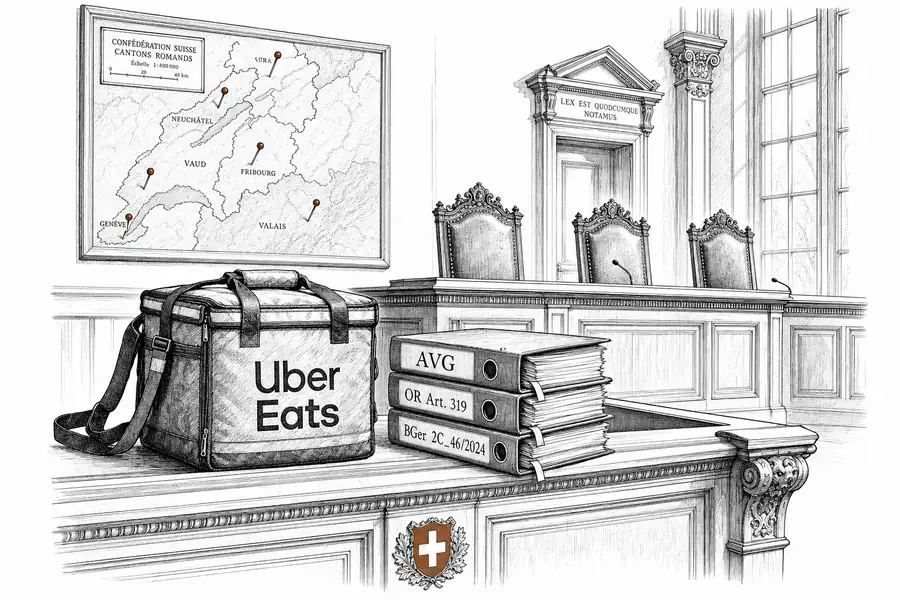
This interpretation is available to any authority in Romandy. The courts of the canton of Vaud applied the same subordination analysis in the Uber context as early as 2020 — for drivers, under the same statutory sources. Neuchâtel, Fribourg, Valais and Jura share the same Federal Supreme Court case law. The next classification decision does not require parliamentary action. It requires a cantonal labour office applying the Chaskis test.
For in-house counsel at platforms with Swiss operations, this reshapes the due diligence logic ahead of the next financing round or trade sale. The risk is segmented by canton. The Geneva and Vaud footprint is classified; around 400 bicycle couriers at Chaskis have been reclassified accordingly. A Romandy-wide sale carries latent back-contribution claims under AHV, UVG and ALV (Art. 12 AHVG; Art. 66 UVG). This exposure feeds into the completion accounts mechanism. A term sheet that does not break down classification exposure at cantonal level leaves the buyer in the dark. The disclosure letter must be resolved at cantonal level — otherwise it will not hold against the corresponding SPA warranties.
Known: Geneva has the framework; Vaud has adopted it. Open: which Romandy canton will apply the Chaskis test next, and to which platform. Smood — the Geneva-based competitor alleged to have circumvented the CCNT — is the obvious candidate. What resolves the open question: the next decision by a Romandy cantonal labour office examining the essential supervisory powers of a platform. Until then, the cantonal risk map belongs in every platform due diligence.