
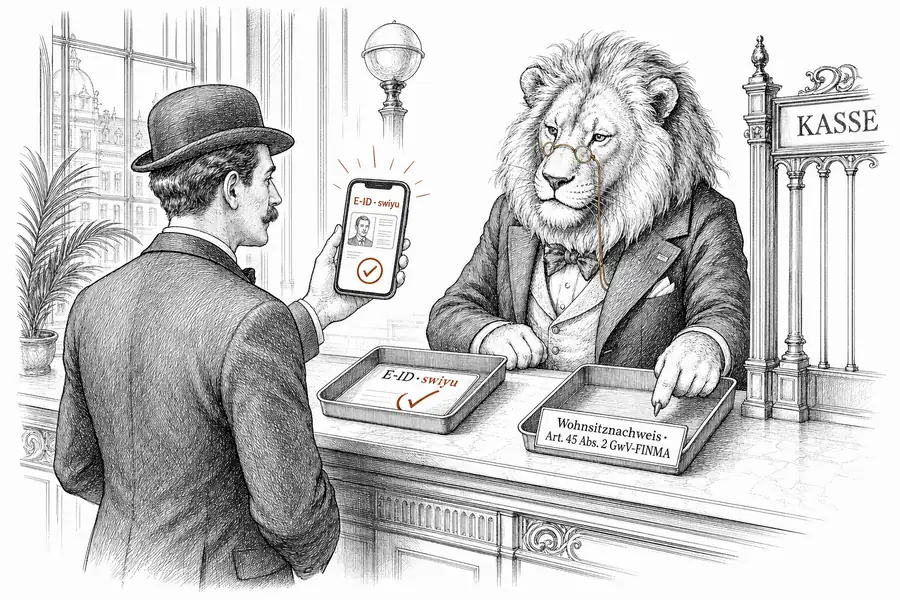
The E-ID Proves Identity, Not Domicile
FINMA has accepted the state-issued E-ID in its revised Circular 2016/7 as a fully valid identification document. But it covers identity only — not proof of domicile under Art. 45(2) GwV-FINMA. Institutions that retool their onboarding around it will save the video session, not the address-verification step.
Dr. iur. Servatius von Tatzenberg
According to the federal government, the state-issued E-ID should be available to order from 1 December 2026, issued by fedpol and stored in the swiyu wallet. For the identification of the contracting party under Art. 3(1) GwG, this shifts the question. It is no longer whether FINMA recognises the new identification instrument — the draft revised Circular 2016/7 “Video and Online Identification” already does. The question is how far that recognition extends: the E-ID proves who the contracting party is, not where they live. Proof of domicile under Art. 45(2) GwV-FINMA remains a separate, mandatory step.
The new instrument does its work where onboarding used to cost money. Anyone obtaining an E-ID undergoes a one-time state identity check in person at a cantonal registration centre. That is the same check every financial intermediary currently conducts for each client — a live-operator video identification with document security-feature verification. The E-ID lifts that check out of the individual business relationship and turns it into a state-administered upstream step that the intermediary need only verify cryptographically.
On the identity side, recognition is doctrinally straightforward. Art. 3(1) GwG requires an evidential document. A state-issued, cryptographically signed identity satisfies that standard and is no less reliable than the video call it replaces. As we noted on 20 May, the draft revised Circular 2016/7 accordingly treats the E-ID under BGEID as a fully valid alternative to physical identity documents, provided the intermediary verifies the credential’s validity and the holder’s attribute binding. The Swiss Bankers Association had asked FINMA for precisely this opening; in the outcome, it has received the half that concerns identity.
FINMA is simultaneously revising the GwV-FINMA itself. That consultation runs until 9 June and concerns ownership structure and sanctions screening, not the E-ID. The E-ID question sits in the circular, and there it is answered — for identity.
The line is drawn by Art. 45(2) GwV-FINMA. Any institution that opens a business relationship without an in-person appearance must verify the contracting party’s domicile separately. The E-ID does not help here, and the reason lies in the credential itself: the Swiss passport and identity card record the place of origin, not the current residential address. The E-ID inherits that gap because its attributes are drawn from precisely those documents — they carry no residential address. Where the German national identity card bears a street address, its Swiss counterpart is silent, and so is the E-ID.
That distinction is not a formality. Residential address is a risk attribute: it drives country screening, tax status, and the plausibility of the business relationship. A pristine E-ID relieves the intermediary on the identity side; it does not relieve it of the domicile check. If the verification required by Art. 45(2) GwV-FINMA is omitted, the identification is incomplete and the due diligence obligation is breached, however cleanly identity has been established. The revised circular accordingly keeps proof of domicile separate and has in fact expanded the permitted methods.
A second limitation reaches further still. Identification is not the whole of onboarding. The E-ID says nothing about the beneficial owner under Art. 4 GwG, nothing about the source of funds, nothing about the risk classification of the relationship. Anyone who treats the E-ID as the solution to client onboarding is confusing the identity document with the client file.
The efficiency gains are therefore real but bounded. What falls away is the expensive portion: the live video call, the document forensics, the client dropping out mid-session. What remains are two items: verification of validity and attribute binding — a light step — and proof of domicile. The E-ID is voluntary; on 28 September 2025 it was approved by the narrowest of margins, 50.4 per cent. Both factors combined mean slow adoption, and every financial intermediary — including GwG-obligated life insurers — will run both tracks in parallel for the foreseeable future.
The weight falls hardest on fintechs. Neo-banks have built their growth on frictionless remote onboarding, and for them the elimination of the identity session is a strategic gain. But the E-ID does not deliver on the promise of the instant account: as long as proof of domicile stands as a separate intervening step, onboarding remains multi-stage. The E-ID removes one step from entry; it does not make entry single-step.
The EU has resolved the same problem differently. eIDAS 2.0 creates the technical and legal foundation with the EUDI Wallet; the AMLR (Regulation EU 2024/1624), applicable from 2027, obliges regulated entities — including banks and financial service providers — to accept the wallet for client onboarding. At high assurance level, wallet-based identification is considered equivalent to an in-person appearance under analyses of the EBA’s draft technical standards. There too, address remains a separate question that identity verification does not answer. Brussels has written the recognition into statute and set a deadline; Bern has written it into a circular — recognised, but without a mandatory acceptance obligation.
For the legal department, the practical mandate is clear. Do not dismantle the video and online track under Circular 2016/7; instead add the E-ID as an additional channel alongside it, attaching to it the same proof-of-domicile requirement as any other remote onboarding. Then segment the client base: the E-ID carries its weight early for domestic private clients; for cross-border relationships, legal entities, and individuals without a Swiss identity document, the existing track remains.
Whether the E-ID will one day deliver proof of domicile as well depends on a second instrument. The BGEID’s full name is the Federal Act on Electronic Identity Documents and Other Electronic Credentials, and the swiyu infrastructure is technically designed for additional official credentials. If an official confirmation of domicile drawn from the municipal residents’ register is issued as such a credential and FINMA recognises it for the purposes of Art. 45(2) GwV-FINMA, the second step falls away too. When that happens will become clear from the definitive version of Circular 2016/7 following evaluation of the responses received, and from the cantonal roll-out of such credentials. Until then, the E-ID changes the cost of proving identity, not the obligation to establish domicile.