
The 'Enforcement Gap' in Foreign Bribery Is a Gap in Your Compliance Programme
Art. 102(2) StGB exposes Swiss companies to criminal liability for foreign bribery they failed to organise against — regardless of whether any individual is ever convicted. The much-cited 'enforcement gap' describes prosecutorial restraint, not the law. It protects no company with a thin programme.
Dr. iur. Servatius von Tatzenberg
Writing about Swiss foreign bribery means writing about a gap. Too few prosecutions, too many quietly issued penalty orders, fines that feel symbolic. But this “enforcement gap” describes what prosecutors do, not what the law requires. Art. 102(2) StGB holds a company criminally liable for foreign bribery it failed to organise against, and it does so regardless of whether any individual is ever convicted. The gap that matters to the legal department is in the compliance programme.
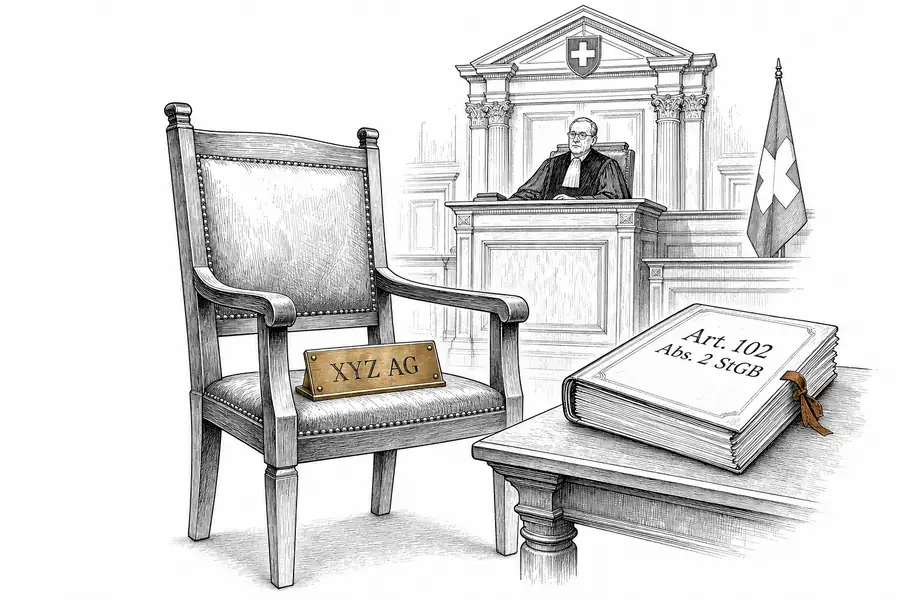
The mechanism is in the statute. Under Art. 102(2) StGB, a company is punishable if it can be charged that it “did not take all necessary and reasonable organisational measures” to prevent a catalogue offence. Bribery of foreign public officials under Art. 322septies StGB is on that catalogue. The charge therefore does not target the bribe itself but the organisational deficiency. This liability is primary: it runs alongside the criminal responsibility of the individual actor, not in place of it.
The distinction from paragraph 1 is decisive here. Under Art. 102(1) StGB, a company is liable only subsidiarily — where the offence cannot be attributed to any specific person because of deficient organisation. For the bribery catalogue in paragraph 2, that condition does not apply. There, the company is liable cumulatively, solely on account of the organisational failure, and identifying an individual perpetrator does nothing to relieve it of that burden.
This shifts the critical question. What now matters is whether the company can demonstrate that it took all reasonable precautions. The common reassurance — that you can never pin it on any one person — describes the trigger for corporate liability, not its outer limit.
Practice confirms this. In its penalty order against Geneva-based commodities trader Gunvor in October 2019, the Office of the Attorney General imposed a fine of CHF 4 million and a compensatory forfeiture order of nearly CHF 90 million for bribes it had failed to prevent in the Republic of Congo and Ivory Coast. The charge of organisational failure under Art. 102(2) StGB was the decisive basis. The authority also credited the company for having introduced anti-corruption measures to recognised standards from 2012 onwards. The programme featured as a factor in calibrating the penalty.
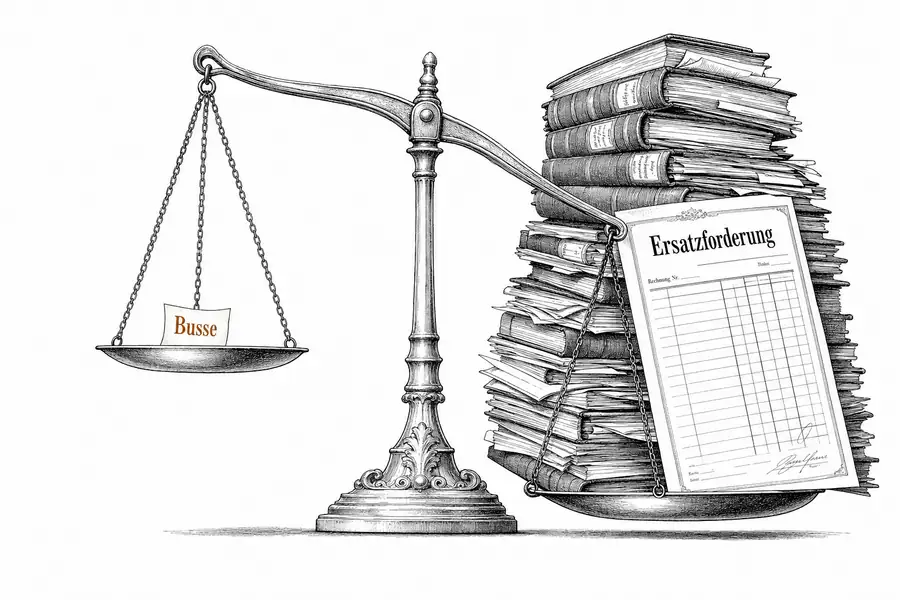
That shows where the real costs lie. The fine under Art. 102(1) StGB is capped at CHF 5 million. Forfeiture of unlawfully obtained profits under Art. 70 et seq. StGB carries no such cap. At Gunvor, the compensatory forfeiture of around CHF 90 million dwarfed the CHF 4 million fine. Anyone who sizes up a sanction by reference to the fine ceiling is measuring the wrong number.
The Trafigura case took this principle to open court. On 31 January 2025, the Federal Criminal Court in Bellinzona convicted commodities group Trafigura — the first time a corporation of that scale had been convicted in full criminal proceedings rather than by penalty order. The case concerned bribes paid to the then-head of a subsidiary of Angola’s state oil company Sonangol between April 2009 and October 2011. Three individuals were convicted alongside the company, including former chief of operations Mike Wainwright, who received a 32-month sentence, 12 months of which were to be served unconditionally. The company itself received a separate fine of CHF 3 million. The fact that individuals were convicted did not exonerate the firm: corporate liability under Art. 102(2) StGB stands alongside individual punishment, not behind it.
Here too, it is the forfeiture that dominates. The compensatory forfeiture order of around USD 145 million exceeds the fine by a factor that renders the fine almost incidental. The verdict is not yet final. Trafigura may appeal to the Appeals Chamber and from there to the Federal Supreme Court (Bundesgericht). Whether the combination of a modest fine and a large forfeiture survives scrutiny will only be resolved on appeal.
Against that backdrop, the “enforcement gap” can be put in its proper place. The OECD Working Group on Bribery criticised Switzerland in 2018 for publishing penalty orders in foreign bribery cases with insufficient transparency and for sanctions against both individuals and companies that were not adequately deterrent. Transparency International simultaneously ranked Switzerland in 2022 as one of only two active enforcers globally, alongside the United States. Both findings measure state activity. Neither one reduces the obligation Art. 102(2) StGB places on companies.
That shifts the focus back inside. Two days ago in this publication, the argument was made that a gifts policy carries more practical weight day-to-day than the criminal law. It prevents the act, whereas Art. 102(2) StGB creates liability only once prevention has failed.
From that follows the work for next week. Every case discussed here ran through intermediaries — advisers and agents who passed payments down the chain. It is precisely there that Art. 102(2) StGB demands demonstrable evidence of necessary and reasonable precautions: third-party due diligence, payment controls, training, auditable records. Formally, the prosecution bears the burden of proving organisational failure (Art. 10(3) StPO). In practice, only a company that documented its precautions beforehand has a defence to mount.
“Reasonable” means proportionate to risk. A commodities trader operating in high-risk markets owes more than a domestically focused mid-size manufacturer: more rigorous vetting of intermediaries, tighter payment authorisation, documented escalation procedures. Courts will measure a company’s precautions against its risk profile, not against a template policy pulled from a drawer. That is precisely why a thin enforcement record is not a safety margin. Only the cases the state picks up become visible; the risk in all the others is merely unobserved.
The “enforcement gap” is real. It measures how rarely and how quietly the state moves. It says nothing about the obligation Art. 102(2) StGB imposes on companies, and it protects no company with a thin programme. What the price looks like in a worst case will be settled by the Trafigura appeal. What reduces it is shown in the Gunvor penalty reasoning: even retrospectively documented measures were treated as mitigating factors — a programme that was in place before the conduct occurred carries all the more weight.