
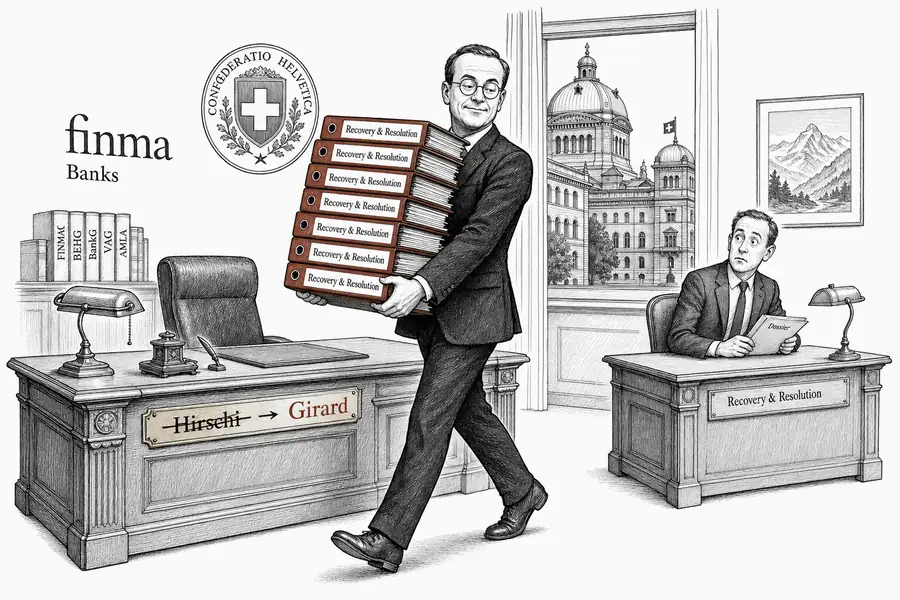
With Girard at the Head of Banking, Art. 60 BankV Enters Day-to-Day Supervision
Alain Girard, who has led FINMA's Recovery & Resolution division since 2022, took charge of the Banks division on 1 April 2026. The annual resolvability assessment under Art. 60 et seq. BankV moves with him from a specialist unit into the mainstream supervisory dialogue.
Casimir von Firn, MLaw
Alain Girard, 45, a lawyer who has led FINMA’s Recovery & Resolution division since 2022, took over as head of the Banks division on 1 April 2026 (FINMA press release, 18 February 2026). He succeeds Thomas Hirschi, who left the authority at the end of August 2025. Anyone whose supervisory dialogue was calibrated to Hirschi’s methodical style should recalibrate: the stabilisation plan now ranks as a standard review document.
The mechanics are in the statute. Art. 9(2)(d) BankG requires systemically important banks to maintain an organisation that, in a crisis, ensures the continuation of systemically important functions and enables recovery or orderly wind-down. Art. 60 et seq. BankV operationalises this through three documents: the emergency plan, the stabilisation plan, and the resolvability assessment; where shortcomings are identified, FINMA may impose surcharges on gone-concern capital requirements and on liquidity requirements. Until now, these assessments were the specialist domain of a separate division. Its former head now sits in the chair that conducts the supervisory dialogue with the banks.
Two operational consequences follow. The four systemically important Swiss banks (UBS, PostFinance, Raiffeisen, Zürcher Kantonalbank) will need to treat their stabilisation plan in the next cycle not merely as a mandatory document but as one subject to substantive supervisory scrutiny — ticking the documentation box will no longer be enough. For non-systemically-important institutions, transitions between supervisory categories will become more transparent: Girard headed the small banks supervisory unit from 2019 to 2022 and helped build the small banks regime; he knows the thresholds from both sides. Simon Brönnimann takes over Recovery & Resolution on an interim basis; he has been at FINMA since 2007 and had been heading the Banks division on an interim basis since September 2025.
Girard is a member of the FSB Resolution Steering Group and the High-Level Task Force for Bail-in Execution (FINMA press release, 18 February 2026). Following a broad internal and external search, CEO Stefan Walter cited Girard’s crisis experience and international supervisory network as the grounds for the appointment (Finews, 18 February 2026). What remains open is whether the resolvability surcharges under Art. 60 et seq. BankV will be applied more frequently under new leadership; no publicly documented cases in which FINMA has imposed such surcharges are known. The FINMA Risk Monitor in November 2026 will provide the answer: the banking section is the first publication to reflect the priority profile under Girard. If resolvability appears there as a theme in its own right, it will be clear that the shift in approach has reached the supervisory cycle.