
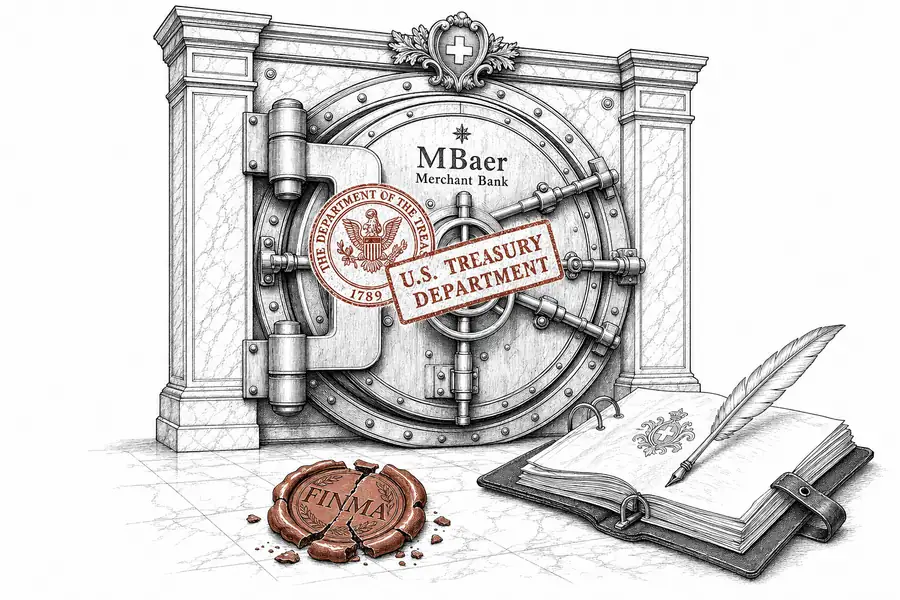
MBaer's Appeal Survived FINMA; It Did Not Survive Washington
FINMA's early-February 2026 licence revocation against MBaer Merchant Bank AG carried suspensive effect on appeal. FinCEN's Section 311 notice did not — and once a Swiss merchant bank loses its U.S. dollar correspondent line, the rest is paperwork.
Casimir von Firn, MLaw
MBaer Merchant Bank AG appealed FINMA’s early-February 2026 Bewilligungsentzug and obtained aufschiebende Wirkung under Art. 55 VwVG from the Bundesverwaltungsgericht. Less than a month later, on 26 February 2026, the U.S. Treasury’s Financial Crimes Enforcement Network (FinCEN) issued a notice of proposed rulemaking under section 311 of the USA PATRIOT Act, designating MBaer a “primary money laundering concern” and proposing the Fifth Special Measure — the mechanics of which are analysed by WilmerHale. The appeal was withdrawn the next day. The FINMA order only had to be ratified once the U.S. dollar correspondent line was gone.
That sequence is the central fact of the case, and the one Swiss correspondent banks should be reading carefully. The reading that FINMA shut MBaer down holds only if you stop at the press release.
What the Fifth Special Measure actually does
Section 311 lets the U.S. Treasury Secretary designate a foreign financial institution a primary money laundering concern and impose one or more of five special measures. The Fifth is not a fine, not a freeze, and not a referral. It bars any U.S. financial institution from opening or maintaining a correspondent account for the designated bank, and obliges those U.S. institutions to take reasonable steps to block indirect access through other correspondent relationships. Operationally:
- No U.S. bank may hold a correspondent account for MBaer.
- No U.S. bank may settle a payment for MBaer through a third party.
- Every U.S. bank must enhance due diligence on its remaining correspondents to prove the prohibition is honoured.
A merchant bank denied U.S. dollar correspondent access cannot clear a U.S. dollar wire. MBaer had, per the NPRM, only one direct U.S. correspondent relationship; the Fifth Special Measure extinguished it and closed any indirect route through third-party clearing. The comment period ran through 1 April 2026, and Sullivan & Cromwell expects the rule finalised in short order. De-risking by U.S. correspondents began the day the NPRM published, not the day the rule turns final.
What FINMA had on the file
FINMA’s findings were grave, and would have been sufficient on a Swiss view alone. The enforcement decision, concluded in early February 2026 after proceedings opened in 2024, recorded that 80% of MBaer’s business relationships carried increased risks and that 98% of assets received in the most recent reporting period came from high-risk clients (CHF 4.9 bn in client assets as of end-2025, on FINMA’s figures). FINMA concluded that MBaer had “systematically failed” to investigate the background of those relationships and had enabled clients to circumvent official asset freezes.
These are Art. 6 GwG findings — the clarification duty for transactions of unusual structure — dressed in supervisory adjectives. The breach is real. What it did not produce on its own is closure: the decision was appealed, aufschiebende Wirkung attached, and the licence remained operative pending review. The bank kept its accounts and its name on the door for three weeks longer than its U.S. dollar clearing did.

Why the appeal was withdrawn
A successful appeal to the Bundesverwaltungsgericht would have restored the banking licence. It could not have restored a correspondent line at any U.S. clearing bank. The Fifth Special Measure binds U.S. banks, not MBaer; the U.S. banks were going to comply with the proposed rule from the moment the NPRM dropped, whatever a Swiss court eventually said about FINMA’s evidence-gathering.
WilmerHale raises the possibility that the two inquiries ran in coordination for years, with FINMA building the record and FinCEN timing its NPRM to the Swiss conclusion. The appeal’s timing argues the opposite reading. MBaer contested FINMA’s order without hesitation and withdrew only after the NPRM dropped. The operative trigger was the U.S. action, not the Swiss decision.
By 27 February 2026 MBaer faced two parallel orders:
- FINMA’s order — contestable, suspensively effective on appeal, governed by Swiss administrative law.
- FinCEN’s proposed rule — not contestable in Switzerland, not subject to suspensive effect anywhere relevant, operationally enforced by every U.S. correspondent on receipt.
Swiss counsel is practised at litigating the first. The second runs through the wires before counsel can file anything. The liquidators, Prof. Daniel Staehelin and Dr Lukas Bopp of Kellerhals Carrard, inherited a bank whose operating licence mattered less than its terminated SWIFT correspondent file.
What the file leaves open for other banks
The MBaer file is closed; the precedent it sets is not. A FinCEN 311 designation against a Swiss bank now functions, in practical terms, as a licence trigger that FINMA only has to ratify — even where FINMA’s own enforcement decision sits under appeal. Two specific implications for in-house counsel at any Swiss bank with material U.S. dollar exposure:
- The FINMA reporting obligation under Art. 29 FINMAG covers “events of substantial importance for supervision”. A formal FinCEN inquiry — well before an NPRM — is on its face such an event. Counsel should not wait for the Federal Register entry to disclose; FINMA has not published guidance to the contrary since the MBaer matter, and treating the obligation as continuous from first U.S. contact is the conservative read.
- Where U.S. and Swiss timelines diverge by weeks rather than days, the board’s choice of which forum to contest first is outcome-determinative. The MBaer board chose Bern and not Washington; the Washington action came too late to contest before the U.S. side had moved. Whether that sequencing was a strategic choice or an oversight, the precedent is set: contesting only the Swiss forum is contesting a downstream consequence.
The near-term event that settles whether MBaer becomes a template is the final FinCEN rule itself, which Sullivan & Cromwell expects in short order following the close of the 1 April comment period. Its publication will confirm whether the Fifth Special Measure becomes the U.S. instrument of choice for designating further Swiss banks with concentrated high-risk client books, or remains a single response to a single file. Counsel should track the Federal Register entry that follows the NPRM cited above — that is what tells the rest of the market whether the MBaer sequence is precedent or anecdote.