
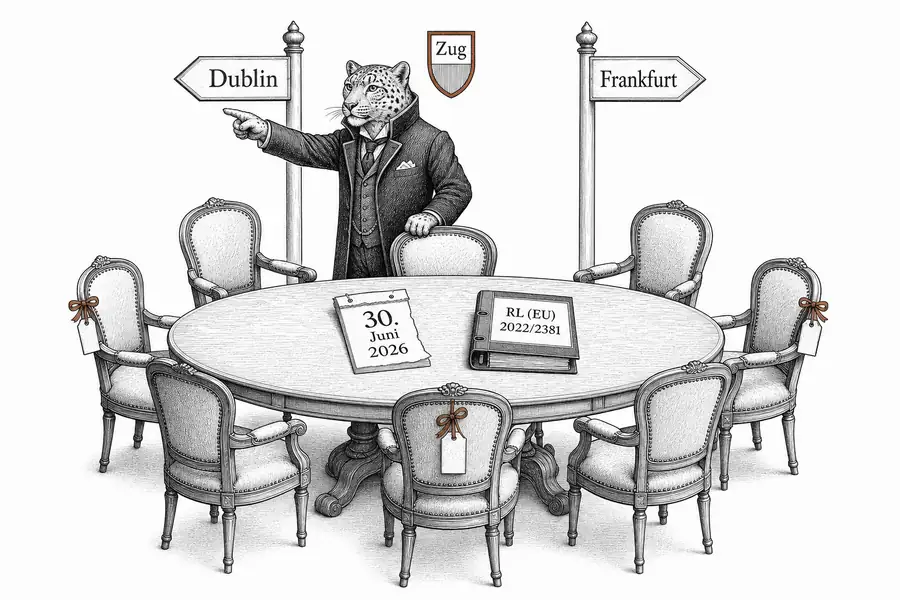
Domicile Plus Listing: The 40 Percent Deadline Counts Your EU Subsidiaries One by One
The target set by Directive (EU) 2022/2381 expired on 30 June 2026. Under Art. 3(1), it turns on each company's own registered office and stock exchange listing — for Swiss groups, that means a separate assessment for every EU-listed subsidiary, with the outcome depending on where each one is domiciled.
Casimir von Firn, MLaw
On 30 June 2026, the target set by Directive (EU) 2022/2381 expired: 40 percent of non-executive board seats for the underrepresented sex, or 33 percent of all board seats (Art. 5(1)(a) and (b)). Under Art. 3(1), a company is covered if it meets two cumulative criteria: registered office in a Member State, and admission of its shares to trading on a regulated market. The group’s own registered office plays no role in the provision. The deadline therefore doesn’t run against your holding company in Zug — it runs separately against each EU-incorporated, EU-listed group company.
Which variant applies is determined by the Member State where the company has its registered office, not by the company itself. The calculation follows the Annex, which caps at 49 percent: a board with six non-executive members satisfies the 40 percent variant with two seats, not three; with seven members, it takes three. Below the SME threshold in Art. 3(8) — fewer than 250 employees and no more than EUR 50 million in turnover or EUR 43 million in total assets — the Directive doesn’t apply at all, per Art. 2. Whether the figures of a parent group headquartered outside the EU count toward that threshold is left open by Art. 3(8): the provision measures the individual company only, and nothing in the text imposes a group-level consolidation requirement. In practice, that means the SME test is applied at the level of the EU subsidiary, not the group.
The common reading — that the Directive penalizes missing the quota — isn’t borne out by the text. Art. 8(1) ties sanctions to infringements of Art. 5(2), Art. 6 and Art. 7; it doesn’t mention Art. 5(1). The route to liability runs through Art. 6(1), which applies only to companies that have missed the target. They must revise their selection procedure, give preference to the underrepresented sex where candidates are equally qualified (Art. 6(2)), and disclose the qualification comparison to a candidate under consideration on request (Art. 6(3)). If that candidate credibly establishes equal qualification, the burden shifts to the company to prove it did not breach Art. 6(2) (Art. 6(4)). What follows is a fine and, where national law provides for it, judicial annulment of the appointment.
Whether this chain of liability is triggered at all is likewise a matter for the Member State — though not at its discretion. Art. 12 permits suspending Art. 6 and, where relevant, Art. 5(2) only if the state had already reached the 30/25 percent threshold by 27 December 2022, or had an equivalent binding national quota scheme with a sanction mechanism in place (Art. 12(1)(a) and (b)); in that case, the targets in Art. 5(1) are deemed met. Germany has suspended, relying on the FüPoG and FüPoG II. Ireland has not: the European Union (Gender Balance on Boards of Certain Companies) Regulations 2025, S.I. No. 215 of 2025, have applied the full selection regime since 29 May 2025, and from 1 December 2027 the competent Minister may publish the names of non-compliant companies. For the German and Irish subsidiaries of the same Swiss group, the assessment therefore comes out differently.
The parent company doesn’t relieve them of any of this. Art. 734f OR sets it a 30 percent benchmark and, where the board falls short, a duty to explain in the compensation report — for the first time for financial year 2026 — but the provision carries no fine and no invalidity of the election. Both regimes measure the board of the individual company, and a group-wide average answers neither. So list every group company with a registered office in a Member State and shares admitted to trading on a regulated market, work out the applicable variant and any suspension for each state of domicile, and carry the result into the next board renewal.
The picture is clear where transposition has happened, or where suspension has been declared. It’s open where neither has: on 31 January 2025, the Commission sent letters of formal notice to 17 Member States — eleven with no notification of transposition at all, six with only partial notification — including Austria, the Netherlands and Luxembourg. A directive has no direct effect against a private company (Court of Justice of the EU, C-91/92, Faccini Dori). What applies there will emerge from the Member States’ transposition report under Art. 13(1), due on 29 December 2027.