
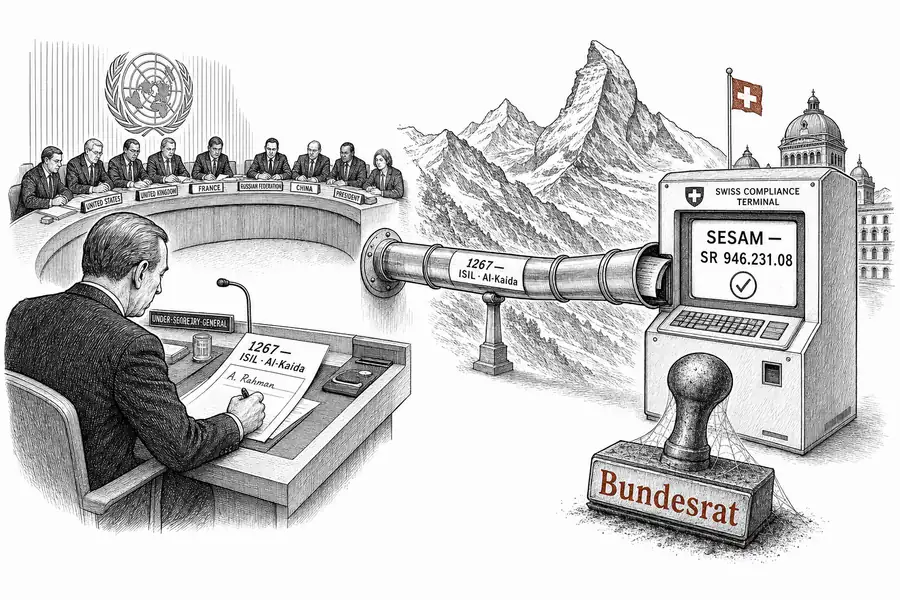
Listed on the UN Track: SR 946.231.08 Bypasses Country-Programme Screening
Since 21 March 2025, the ISIL/Al-Qaida list SR 946.231.08 has operated on the UN-1267 track: names bind in Switzerland automatically the moment the Committee in New York lists them — without a Federal Council ordinance and without an autonomous delisting route. Screening calibrated to ordinance amendments or the EU list will carry a stale list between UN updates.
Dr. iur. Servatius von Tatzenberg
There is a Swiss sanctions list that does not wait for a Federal Council ordinance. Since its complete revision on 21 March 2025, it bears the number SR 946.231.08 and implements the UN regime against ISIL (Da’esh) and Al-Qaida under Security Council Resolution 1267 (1999) and its successor resolutions. Anyone listed is blocked in Switzerland as soon as the Sanctions Committee in New York adds their name. No order from the Federal Department of Economic Affairs, Education and Research (EAER), no publication in the Official Compilation, no EU package precedes it.
This is by design. Art. 1(1) of the Embargo Act (SR 946.231) gives the Federal Council a choice: it may impose coercive measures to enforce sanctions adopted by the UN, the OSCE, or Switzerland’s principal trading partners. For Security Council decisions taken under Chapter VII of the UN Charter, that discretion falls away: Art. 25 of the UN Charter obliges member states to accept and carry out such decisions. The Ordinance of 4 March 2016 on the Automatic Adoption of UN Security Council Sanctions Lists converts this into direct implementation: amendments to the UN name lists take effect immediately, without the Federal Council enacting each one individually.
This is where the list diverges from the country programme. The ordinances against Russia, Iran, or Venezuela are amended by the Federal Council itself, with a dated decision and an entry in the Official Compilation. The ISIL/Al-Qaida names grow without any of that. The critical point: the freezing obligation arises with the Committee’s decision, not with the SESAM update. On 16 June 2025 the Committee resolved a list amendment; SECO updated SESAM on 18 June 2025 — two business days later. Anyone who ran their screening against SESAM on 17 June saw no match — but was already bound.
Many screening setups treat the EU, UN, and OFAC lists as three parallel feeds, paced to provider updates — a model rooted in German compliance practice and directed primarily at §25h of the German Banking Act (KWG). For country sanctions, this assumption holds for Switzerland, because the Federal Council follows the EU. For the 1267 list it does not: what governs is not the EU list but the state of SESAM, and the trigger sits with the Committee, not in a Swiss or Brussels legal act. Those who key their screening to ordinance amendments carry a stale list between UN updates. It is the same gap as with the Venezuela list and the lag behind Brussels — this time without any legislative act that would even signal its presence.
The second trap is delisting. For an autonomous Swiss measure, the person concerned can file an objection with SECO and bring proceedings before the Bundesverwaltungsgericht under Art. 31 of the Federal Administrative Court Act (VGG) in conjunction with Art. 44 of the Administrative Procedure Act (VwVG). For a 1267 listing, that avenue leads nowhere: only the UN Committee can strike a name, and the sole orderly route runs through the UN Ombudsperson under Resolution 1904 (2009). What this means was spelled out by the European Court of Human Rights in Nada v. Switzerland (no. 10593/08, 12 September 2012): Bern had imposed the freeze but made no attempt to seek a delisting from the Committee — and was nonetheless held liable for breaching Art. 8(1) and Art. 13 of the ECHR.
For the legal department, this has three implications. First: run the screening for SR 946.231.08 daily against SESAM and the Committee’s communications — do not tie it to the ordinance or EU-package cycle; the obligation arises with the Committee’s decision, SESAM follows business days later. Second: a match on the 1267 list triggers a two-track obligation. Notifying SECO does not discharge the duty to conduct additional due diligence under Art. 6 GwG; if that due diligence cannot dispel the suspicion, a report must be filed immediately with the Money Laundering Reporting Office Switzerland (MROS) under Art. 9 GwG. Third: the delisting question belongs in New York, not in SECO’s inbox. The Committee decides when a name is added to the list and when it is removed; the Federal Council implements both — the first within business days, the second not at all.