
SR 196.127.85: The Maduro freeze does not belong in the sanctions workflow
The Federal Council Ordinance of 5 January 2026 freezes 37 Venezuelan assets under Art. 3(2) SRVG, not under the EmbG. Any institution that processes the freeze through the SECO workflow is reporting to the wrong authority and violating Art. 7 SRVG.
Dr. iur. Servatius von Tatzenberg
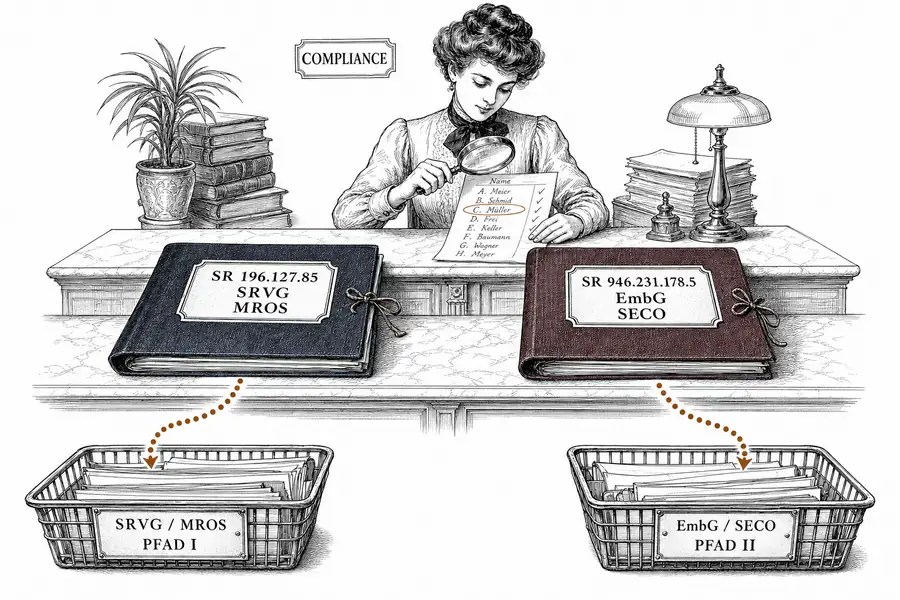
The Federal Council Ordinance of 5 January 2026 (SR 196.127.85) freezes the assets of Nicolás Maduro and 36 other named individuals with immediate effect, without Switzerland needing to impose a new embargo. The legal basis is not the EmbG but Art. 3(2) SRVG — the Act on the Freezing and Restitution of Illicit Assets Held by Foreign Politically Exposed Persons. Any institution that routes the Maduro freeze through the SECO workflow is therefore reporting to the wrong authority: Art. 7 SRVG (SR 196.1) requires notification to MROS at fedpol, not to the sanctions unit of the Federal Department of Economic Affairs, Education and Research (WBF).
The Ordinance lists 37 individuals in its annex; the binding obligation on every financial intermediary holding assets on their behalf, directly or indirectly, took effect at 11 a.m. on 5 January 2026. The freeze does not target members of the current Venezuelan government as such. The Ordinance runs initially until 4 January 2030 — a period of four years — with provision for statutory extension. It supplements the embargo ordinance against Venezuela that has been in force since 2018 (SR 946.231.178.5), which continues to run independently and was updated by the WBF on its regular review cycle on 12 January 2026.
The two regimes run on separate tracks. The trigger for SRVG action under Art. 3(2) SRVG is a political upheaval with restitution prospects — in this case the arrest of Maduro by US forces — not a UN or EU resolution; the list is drawn up by the Bundesrat itself, not by SECO through the sanctions database SESAM. Reports under the SRVG go to MROS at fedpol (Art. 7 SRVG); embargo reports go to SECO through SESAM. Per FINMA’s express guidance, reporting to SECO does not relieve financial intermediaries of the duty to conduct additional due diligence under Art. 6 GwG, nor — where suspicion cannot be dispelled — of the obligation to file a suspicious activity report to MROS under Art. 9 GwG. Failure to freeze assets carries a penalty of up to three years’ imprisonment under the SRVG; breach of the reporting obligation carries a fine of up to CHF 250,000 — two independent offences.
Since 5 January 2026, custody teams have been running Venezuela screening on two parallel tracks. First, an EmbG screening run against the SECO list as updated on 12 January 2026, with reports filed to SECO. Second, a separate SRVG run against the 37-person annex to SR 196.127.85, with reports filed to MROS. Both runs may flag the same client — Maduro has been on the sanctions list since 2018 — but each match must be recorded separately, because MROS and SECO maintain independent files and the regulator queries both tracks independently. Compliance calendars must record 4 January 2030 as the expiry date of the freeze and a review date in October 2029, because without explicit renewal the frozen assets will revert from the SRVG mandate to ordinary commerce or into ongoing criminal proceedings.
It remains to be seen whether the four-year period will end with a forfeiture action by the Federal Department of Finance (EFD) before the Bundesverwaltungsgericht. SRVG restitution proceedings have consistently taken several years. The next visible data point is the annual Federal Department of Foreign Affairs (EDA) report on SRVG implementation (Art. 17 SRVG), which will cover the Venezuela freeze for the first time.