
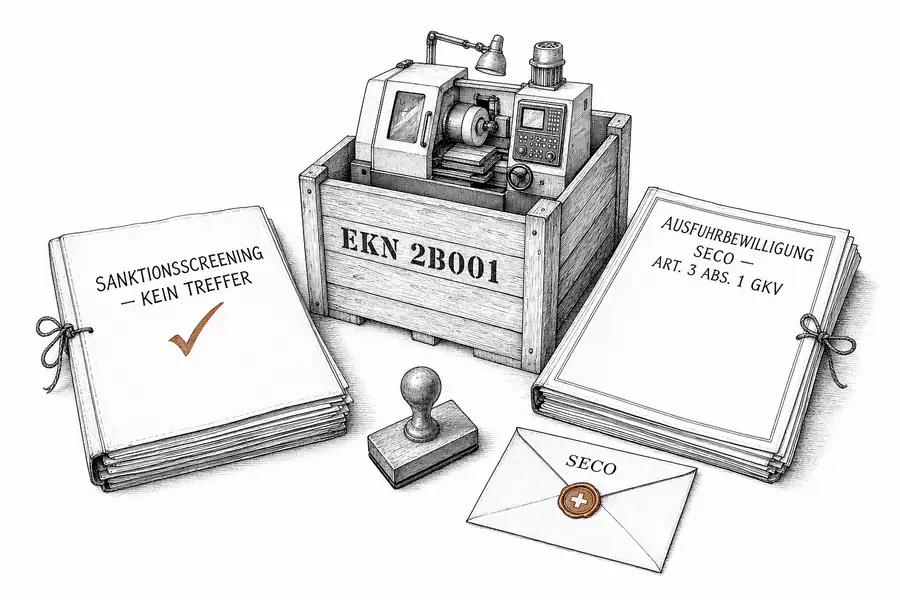
Your Sanctions Screening Came Back Clean. You Still Need the Authorisation Under Art. 3(1) GKV
Art. 3(1) GKV ties the export authorisation to the goods and the declared end use, not to the counterparty's name. Under Art. 6(1)(c) GKG, sanctions operate only as a ground for refusal within the authorisation procedure: a hit blocks the authorisation, but no hit does not create one.
Dr. iur. Servatius von Tatzenberg
Since 1 July 2026, eleven more states have been added to Annex 7 of the Goods Control Ordinance (GKV, SR 946.202.1), and many Swiss exporters read that as relief. The authorisation requirement itself sits in Art. 3(1) GKV, and it attaches to the goods and the declared end use, not to the counterparty. A clean sanctions screening therefore says nothing about whether you may ship — only that one ground for refusal is absent. Anyone who folds both checks into the same release step is signing off on two separate duties with a single tick.
The reason to separate them now is the relief measure itself. On 27 May 2026 the Federal Council amended Annex 7 GKV, Annex 2 of the War Materiel Ordinance and Annex 34 of the Ukraine Ordinance, adding Iceland and ten EU member states from Bulgaria to Cyprus. For Annex 7, that means SECO can now issue an ordinary general export authorisation under Art. 12 GKV for these destination countries, rather than requiring an individual authorisation per shipment. One decision, three annexes, two regimes — and in many companies, a single line in the process manual.
The Duty Attaches to the Goods and the Purpose
Art. 3(1) GKV attaches to a list of goods, not a list of names. Art. 3(3) GKV extends the duty to products that contain listed components, once those components are a principal element or account for more than 25 percent of the value of the goods. Up to this point, it is a classification question — and it gets settled in engineering, not in the compliance tool.
Art. 3(4) GKV then flips the logic. Anyone who knows, or has grounds to assume, that goods are intended for the development, production or use of chemical, biological or nuclear weapons must apply to SECO for an authorisation. Under lit. a, that applies to goods that appear in no annex at all; under lit. b, it applies even where an exemption from the authorisation requirement would otherwise apply. End use trumps the list in both directions.
Where Sanctions Actually Come In
That does not mean sanctions drop out of the process — they simply sit at a different point in it. Art. 6(1)(c) of the Goods Control Act (GKG, SR 946.202) bars the grant of an authorisation where corresponding coercive measures have been ordered under the Embargo Act. That is a ground for refusal within the authorisation procedure, not a substitute for it.
Practitioner guides rightly place the embargo check at the start of the cascade — see, for instance, the short guide by Thommen Law & Risk Management of 15 September 2025. There is nothing wrong with that sequencing. What goes wrong is what process diagrams then do with it: treat a clean first step as shrinking the second.
The second ground for refusal sits in Art. 6(1)(c) GKV — a distinct provision that happens to share its letter with the embargo ground in the GKG. It reads like a description of today’s circumvention trade: SECO refuses an authorisation where there are grounds to assume that the goods will not remain with the declared end recipient. What gets examined is not who placed the order, but where the machine will be standing in two years. Art. 6(2)(a) GKV further factors in a refusal by a partner state toward the same end recipient — a fact that appears on no sanctions list.
Two Declarations, One Document Short
This is the point where, in practice, a form makes its way into the file — and it is often the wrong one. The non-re-export declaration, the End-use Certificate, belongs to war materiel law: SECO bases it on Art. 5a of the War Materiel Ordinance and provides the templates expressly for war materiel. For goods under the GKV annexes, the equivalent document is the end-use declaration, grounded in Art. 8(d) GKV. That provision is discretionary: SECO may require company profiles, purchase contracts, import certificates and end-use declarations for individual authorisations. In practice, it asks for the declaration in almost every individual-authorisation case; the discretionary wording changes nothing about the fact that an application without one rarely gets through. A signed declaration nonetheless remains evidence within the authorisation file — never the authorisation itself.

Two Convictions, No Sanctions Hit
The Federal Supreme Court (Bundesgericht) demonstrated the mechanism in 2018 in an unremarkable case. On 30 August 2016, an exporter declared three “High Performance 10Base-T Ethernet Hubs” for export as authorisation-free, destined for a bank in Luxembourg. SECO had notified the exporter in writing the day before that such goods required authorisation; the declaration went through as authorisation-free regardless. No sanctioned state, no listed counterparty, a bank customer within the EU. The devices fell under EKN (export control number) 5A002.a1 in Annex 2, Part 2 GKV, and in 6B_1032/2017 the Bundesgericht upheld the conviction for attempted violation under Art. 14(1)(a) GKG in conjunction with Art. 3(1) GKV: a suspended fine of 20 daily rates at CHF 450 each, plus a further fine of CHF 1,000.
The second case shows the other half. SRF reported on 9 May 2025 that the Office of the Attorney General of Switzerland had fined a person responsible for exports at Galika AG in Volketswil CHF 1,500 for repeated violations of the Goods Control Act. The individual had knowingly and willfully given false information about the end customer in applications to SECO; the shipments, made in 2020 and 2021, involved machines from Fritz Studer and GF Machining Solutions. That is the offence under Art. 14(1)(c) GKG — false statements in an application — not a breach of a sanctions ordinance. The shipments predated February 2022, and a screening at the time would have found nothing, because it would have been asking the wrong question.
What to Do on Monday
Split the release decision into two dated determinations per shipment: a classification decision with an EKN or a reasoned finding of “no EKN”, and a separate sanctions decision. This is not a formality. The BAZG guidance note “SECO – Dual-Use Goods”, as amended 1 July 2026, states that exporters must be able to prove with documentation, at SECO’s request and at any time, that an export was rightly treated as authorisation-free. In Passar, “Regulierung 0” is a declaration by the person filing the customs entry, not a finding by the authority. Under Art. 18 GKV, the documentation must be retained for ten years after customs clearance — which leaves the burden of proof on you across three changes of personnel.
Anyone looking to use the new Annex 7 relief should first check two preconditions. Art. 5(2) GKV requires legal entities applying for authorisation to demonstrate reliable internal company controls. Art. 10(2) GKV bars the general export authorisation for two years if the applicant, or a member of its governing bodies, has been finally convicted of an offence under the GKG, the War Materiel Act, the Arms Act, the Explosives Act or the Nuclear Energy Act. A fine of CHF 1,500 can therefore cost a company its exemption from individual authorisations for all EEA shipments.
Whether it stops at the individual remains an open question. Art. 16 GKG makes Art. 6 of the Administrative Criminal Law Act (VStrR) applicable to offences committed within a business, and that provision is directed first at the natural person who acted. According to reporting by watson on 29 March 2024, the Office of the Attorney General is also investigating Galika AG itself in the same matter; the company has been in liquidation since March 2024. What that proceeding against the company yields will show whether CHF 1,500 was the ceiling — or just the starting point.