
State Aid Control Without Swiss Precedent: When Your Cantonal Subsidy Becomes Notifiable
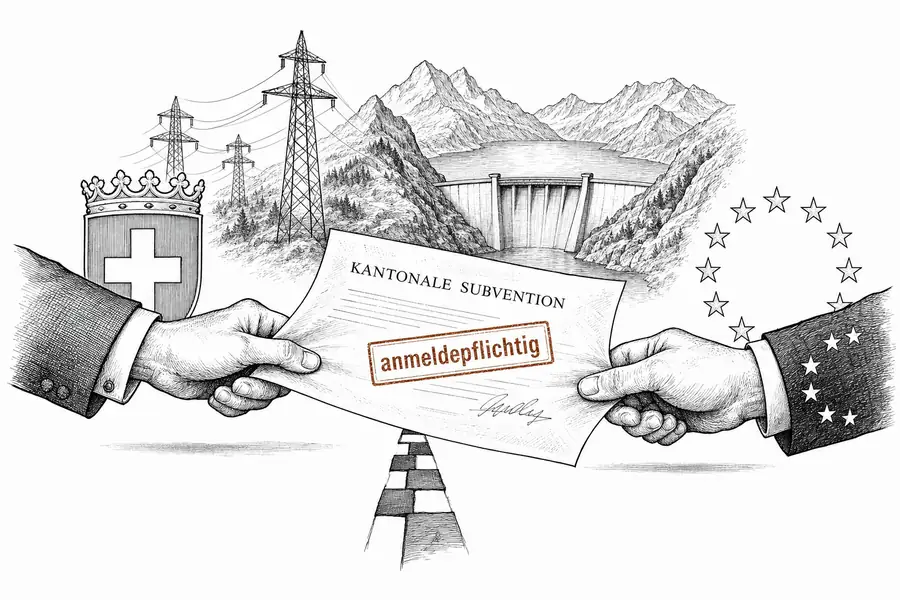
The Switzerland–EU package imports substantive EU state aid law into the electricity, road transport, and air transport agreements, together with a notification requirement for the Confederation, cantons, and municipalities and the possibility of court-ordered recovery. Competition-based recovery is unknown to Swiss subsidy law. The new State Aid Supervision Act creates it.
Dr. iur. Servatius von Tatzenberg
The Switzerland–EU package introduces a legal instrument that Swiss law has not previously known: a competition-based state aid control regime with a notification requirement and the possibility of court-ordered recovery. It does not apply to the economy as a whole — its reach is limited to the scope of the electricity, road transport, and air transport agreements. Within those sectors, Switzerland will adopt the substantive rules of EU state aid law, including the concept of state aid within the meaning of Art. 107 TFEU, as set out in the Bundesrat’s fact sheet of 13 June 2025. Any company receiving a cantonal subsidy, fee waiver, or tax concession in the electricity sector should resolve one question this week: does the measure fall within the scope of the Electricity Agreement? What is treated as settled today could, under the forthcoming State Aid Supervision Act (BHÜG), become subject to notification — and, in an extreme case, to recovery.
Under this framework, a state aid is a selective economic advantage granted to an undertaking from public resources that distorts competition. The fact sheet lists the forms itself: subsidies, concessionary loans, state guarantees, tax concessions. What matters is not the label but the effect. A waiver of a claim by the canton — say, a forgiven concession fee — operates like a payment, because the public body forgoes resources it would otherwise receive. Public service obligations are excluded, and both thresholds and numerous exemptions apply, as they do under EU law.
The granting of support itself remains permissible. What is new is its subjection to competition-law scrutiny. The current Subsidies Act (SuG, SR 616.1) allows recovery only where the recipient can be faulted: inadequate performance of the task (Art. 28 SuG), misuse of funds (Art. 29 SuG), or revocation of a defective administrative decision (Art. 30 SuG). The trigger has always been the recipient’s conduct, never the competition-distorting effect as such — and it is precisely that effect which now becomes an independent ground for recovery. A lawfully granted and properly used subsidy can be recovered because it distorts competition.
The procedure is to be governed by the forthcoming BHÜG; the Confederation has set out the framework in the fact sheet of 13 June 2025 — the time limits and case numbers are estimates from the draft, not settled law. The Confederation, cantons, and municipalities must notify a proposed new aid measure above a threshold value. Review will be conducted by a state aid chamber within the Competition Commission (WEKO): a preliminary examination within two months, and where concerns arise, an in-depth review of up to twelve months, culminating in a non-binding opinion. Before the aid is granted, the final legal act must be communicated to the authority so that it can give its view before payment is made. Only a court can issue a binding decision — with the Federal Supreme Court (Bundesgericht) having the final word and, where appropriate, ordering recovery.
Here Switzerland deliberately departs from the EU model, and the difference matters in practice. In the EU, a general prohibition on state aid is paired with a standstill obligation: a notified measure may not be paid out under Art. 108(3) TFEU until the Commission has cleared it. The Swiss system has no such disbursement ban and no authority that can itself issue a binding prohibition. The supervisory authority does no more than issue an opinion — a canton that disagrees can pay out the aid regardless; a legally binding block arises only through a court judgment. This court-centred design respects the competences of the cantons, the Federal Assembly, and the Bundesrat; the Confederation considers it constitutionally sound.
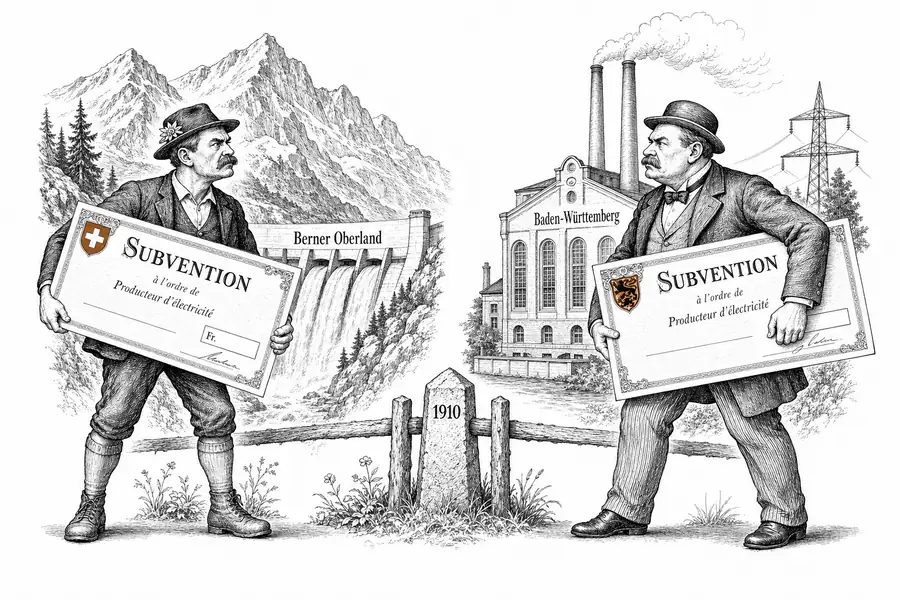
The most significant difference lies in who can trigger proceedings. WEKO already monitors state aid in air transport under the existing air transport agreement, but without any right of complaint. Going forward, a competitor will also be able to file a complaint — and in a shared electricity market, that competitor is often across the border. The Confederation illustrates this itself: an electricity producer from Baden-Württemberg objects to subsidies received by a producer in the Bernese Oberland from Canton of Bern and turns to the Swiss supervisory authority. If the authority considers the subsidies unlawful, it requests Canton of Bern to recover them; if the canton refuses, the Bundesgericht ultimately decides.
The supervisory database makes every notified measure visible to competitors. A subsidy that today appears in a cantonal decision and attracts little notice beyond the region will in future appear on a centralised register. A notification is, at the same time, a map of what a competitor could challenge — a development that meaningfully lowers the threshold for complaints.
The mechanism works in both directions, and therein lies an opportunity for Swiss companies as well. A company competing in electricity or air transport against a subsidised EU rival can in future lodge a complaint with the European Commission about that rival’s aid. The Swiss authority, for its part, examines domestic measures. For the legal department, this means state aid control also functions as an offensive tool against distorting subsidies on the other side. Both sides of the border therefore deserve attention: your own exposure and the challengeable advantages your competitors enjoy.
The weight of the reform falls on electricity. The Electricity Agreement opens the market, and cantonal and municipal support meets European competition there: grants to producers, state guarantees for cantonal energy companies, waived concession or network charges, cross-subsidies from the universal service obligation. Each of these measures can now be assessed against the state aid concept. The Confederation has secured the most important existing electricity aid measures by treaty, notably the promotion of renewable energy. That protection covers existing measures, not every future adjustment — a company that extends or redesigns a protected measure may fall outside the protected perimeter.
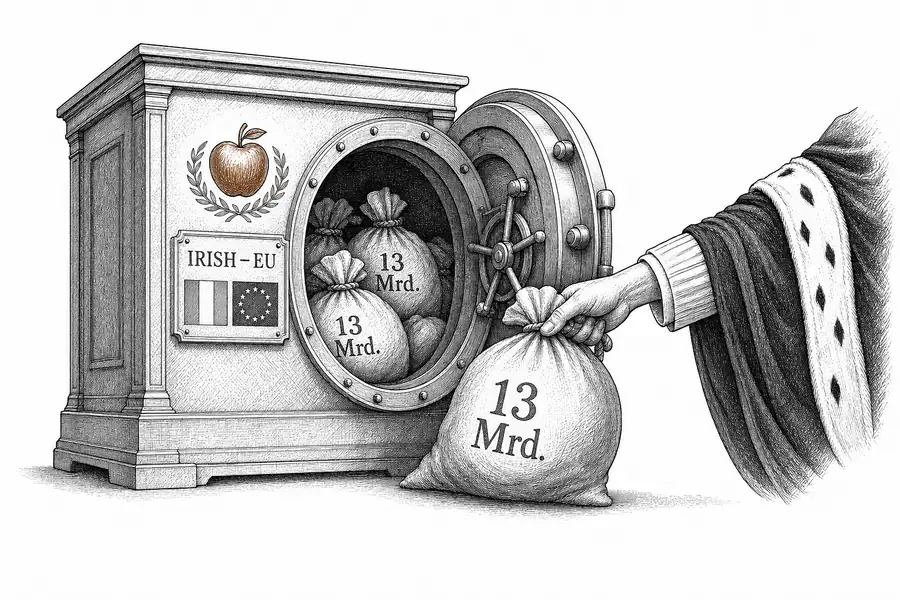
A tax ruling also carries less weight than the legal department may be accustomed to. Under EU state aid law, a binding advance tax ruling can itself constitute state aid if it confers a selective advantage on an undertaking. In the Apple case (C-465/20 P, judgment of 10 September 2024), the Court of Justice set aside the judgment of the General Court and upheld the Commission decision (SA.38373) requiring Ireland to recover approximately €13 billion in principal (€14.3 billion including interest) arising from two tax rulings. The outcome is not a blank cheque: in the Fiat, Amazon, and Engie cases, the Court rejected the Commission on virtually identical theory because the arm’s-length standard applied deviated from national law; Apple prevailed because Ireland had not appealed key findings. For a cantonal tax ruling under the BHÜG, this means the Swiss supervisory authority would have to demonstrate a selective advantage measured against the applicable cantonal tax framework — the mere existence of a favourable ruling is not enough. Switzerland adopts this concept for the electricity sector, and it moves with EU law — the dynamic alignment mechanism of the package was discussed in our 24 May piece. A cantonal tax concession benefiting an electricity company will therefore be measured against the standard of the Court of Justice, not against a purely domestic Swiss reading.
Constitutionally, this cuts deep into cantonal autonomy. Under Art. 3 BV, cantons are sovereign to the extent the Confederation does not limit their competences, and the granting of subsidies is at the core of that independence. Going forward, a canton must notify its own aid measures and, on a request from the supervisory authority, must itself pursue recovery. The loss ultimately falls on the company that received the funds and must repay them. A company that today relies on a cantonal commitment should factor in that, under the BHÜG, the canton no longer has sole control of it.
Existing aid measures do not disappear from view. After a start-up period, the supervisory authority will spend one year taking stock of current schemes. Measures secured by treaty are protected, but the existing landscape will be mapped and, in principle, open to future prospective adjustment. Politically, the last word has not been spoken: the package is signed and the federal message is before parliament, but the BHÜG and, in all likelihood, a popular referendum, still need to be decided. The direction, however, is set — and preparation cannot be deferred to the date of the vote.
The Confederation presents the reform as modest. In volume terms the intervention is narrow: it expects roughly five preliminary and one in-depth review per year over the long term. The scope is tight; the 1972 free trade agreement and public procurement remain outside it, as does domestic public transport. In the consultation running until the end of October 2025, a clear majority supported the package. But a low case count says nothing about the risk in an individual case — the notification requirement, the right to complain, and the power of recovery are new regardless of whether there are five cases or fifty. There is time, however: a five-year transitional period applies to the build-up phase, after which the authority has a further year to review the existing stock.
For the legal department, this translates into a bounded task that starts now. First, inventory the support your company receives or grants within the scope of the Electricity Agreement: subsidies, state guarantees, fee and charge reductions, advance tax rulings. Second, classify each item — does it fall under the treaty-protected existing measures, or would it, as a new measure, be subject to notification? Third, follow the BHÜG debate in parliament, where the design of the supervisory authority is still being discussed. How strictly it reads the selective advantage concept in the electricity market will only become clear from its first in-depth review and the first Bundesgericht judgment under the new act. Until then, the working assumption should be: a subsidy considered settled today may not be under the BHÜG.