
Anyone Who Sells DDP Has Just Hired a Registered CBAM Declarant
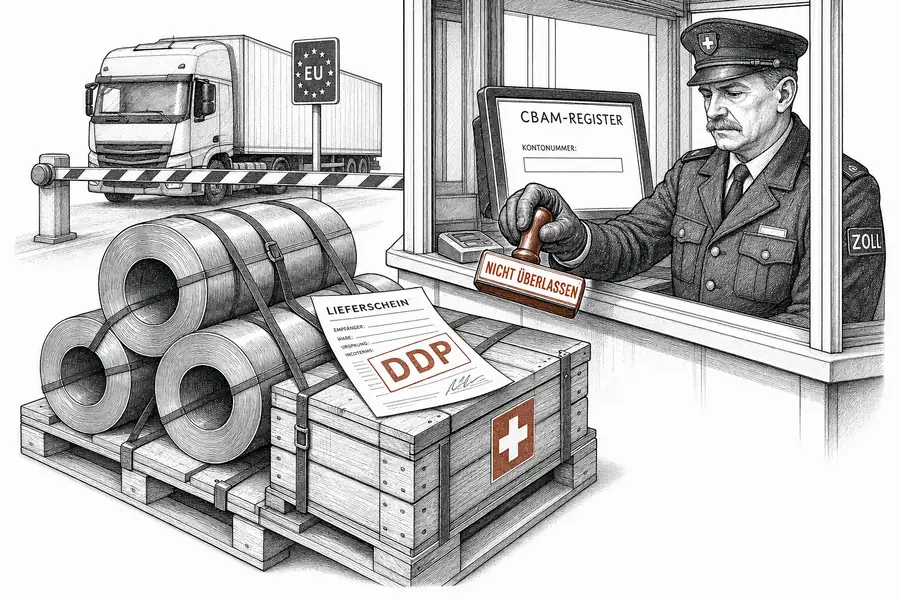
Annex III, point 1 of Regulation (EU) 2023/956 exempts goods of Swiss origin from CBAM. But the exemption attaches to the goods, not the seller: a supplier who delivers DDP into the Union becomes the importer — and an importer with no establishment in a Member State cannot become a registered CBAM declarant under Article 5 at all.
Casimir von Firn, MLaw
The Swiss shorthand on EU CBAM is: we’re exempt. That’s true for the goods, not for the seller. A supplier who delivers DDP into the Union becomes the importer — and an importer with no establishment in a Member State cannot itself acquire registered-CBAM-declarant status, which Article 4 of Regulation (EU) 2023/956 requires for every import, because Article 5(2) rules that out.
The exemption itself isn’t in dispute. Article 2(4) excludes goods originating in the third countries and territories listed in Annex III, point 1; Iceland, Liechtenstein, Norway and Switzerland are on that list because their emissions trading systems sit inside or are linked to the EU ETS. SECO puts it plainly: goods originating in Switzerland are exempt from EU CBAM because the Swiss and EU emissions trading systems are linked. The sentence carries its own limit built in. It speaks to the origin of the goods, not to who is allowed to import them.
What the clause actually does
DDP obliges the seller to handle the import formalities at destination. The seller cannot lodge the declaration itself: under Article 170(2) of the Union Customs Code, the declarant must be established in the customs territory of the Union, and Article 5(31) UCC defines “established” as having a registered office, central headquarters or a permanent business establishment there. So the Swiss supplier needs an indirect customs representative, who declares in their own name but on the supplier’s account — leaving the supplier as importer within the meaning of the Regulation.
That’s where the second chain of obligations kicks in. Article 5(1) lets an importer established in a Member State apply for authorisation in its own right. For everyone else, Article 5(2) is explicit: where the importer is not established in a Member State, the indirect customs representative shall be required to obtain the status of registered CBAM declarant, irrespective of whether the importer is exempt from the obligations under this Regulation pursuant to Article 2a. Article 25(1) turns this into a border control — customs authorities shall not allow the importation of goods by anyone other than a registered CBAM declarant. That’s not a cost question; it’s an admissibility question. The shipment is not released.
What it costs
The relief many suppliers assume they can rely on doesn’t apply here. The de minimis rule in Article 2a, inserted by Regulation (EU) 2025/2083, exempts an importer as long as the cumulative net mass of its CBAM goods in a calendar year stays under the Annex VII threshold — initially 50 tonnes, calculated across iron, steel, aluminium, fertilisers and cement, excluding electricity and hydrogen. The new Article 5(1a) is not tied to any threshold: it requires the indirect customs representative to obtain authorisation before every import. DEHSt, the competent German authority, states expressly that this authorisation is required regardless of whether the importers being represented have exceeded the 50-tonne threshold.
Two obligations need to be kept apart here. The authorisation duty falls on the representative, as described, irrespective of the threshold. The reporting and certificate obligation, by contrast, still depends under Article 2a(1) and (2) on the represented importer’s cumulative annual quantity: below 50 tonnes, that importer has no obligation to surrender CBAM certificates, but the representative’s authorisation is still mandatory regardless. SW Zoll-Beratung, in stating that CBAM certificates become relevant from the first kilogram, has the authorisation side in view — the certificate obligation itself still turns on the individual importer’s 50-tonne threshold.
Then there’s the allocation of duties. Under the equally new Article 5(2a), an indirect customs representative acting as registered CBAM declarant on an importer’s account is subject to the obligations that apply to that importer. Article 17(5) additionally requires a bank guarantee payable on first demand if the applicant has not been continuously established for the two preceding financial years. And Article 26 pegs the penalty to Article 16(3) of Directive 2003/87/EC — nominally €100 per tonne, indexed annually to the EU consumer price index since 2012 under Article 16(4) of the same directive, rising to three to five times that for imports by non-registered declarants. A freight forwarder taking on this role is putting its own authorisation on the line for someone else’s balance-sheet exposure. Unsurprisingly, few offer it.
The second mistake: where goods ship from is not where they originate
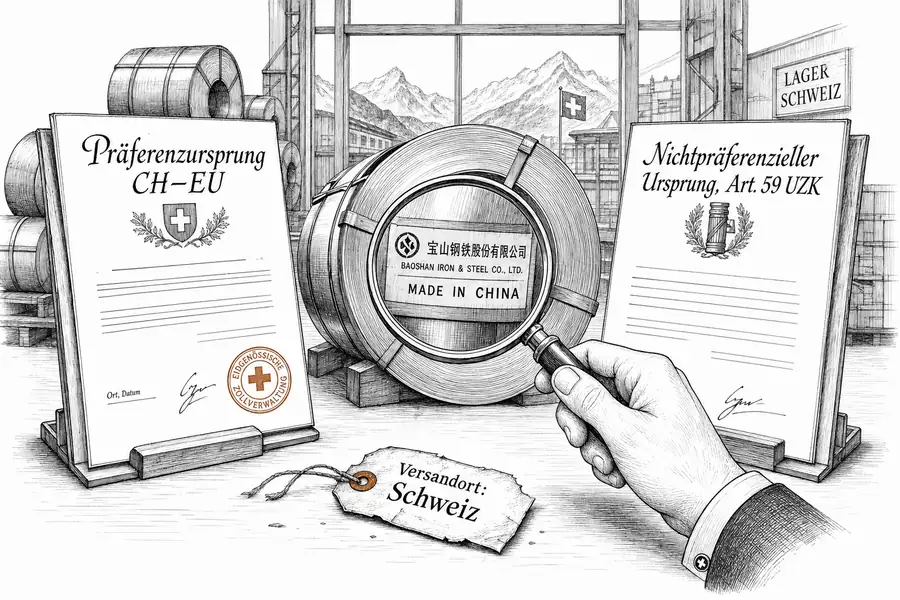
Even suppliers who stick with DDP need to keep the origin question separate. Article 2(5) determines origin under the non-preferential origin rules of Article 59 UCC, not under the preferential rules of the free trade agreement that Swiss export departments apply every day. Chinese steel that is transshipped through a Swiss warehouse and resold without any processing that would confer origin remains Chinese steel; an invoice issued from Zug changes nothing. The practice guide from Douana names this as a recurring error: the place of dispatch, Switzerland, gets confused with the relevant origin of the goods. SECO and the Federal Office for Customs and Border Security have published a joint guide setting the two regimes side by side.
Three steps before the next shipment
First, go through the Incoterms clauses in existing framework contracts and, wherever DDP appears, switch to DAP or FCA: that makes the EU customer the importer, lets them use their own 50-tonne threshold, and leaves the authorisation obligation with them. Second, where DDP has to stay for commercial reasons, bind the indirect customs representative contractually and get its CBAM account number in writing before the next shipment goes out; the Article 17(5) guarantee belongs in the pricing calculation, not in a footnote. Third, for suppliers with regular DDP volumes, check whether they meet the permanent-establishment test under Article 5(32) UCC — staff and equipment present on a lasting basis — which would move the group into the self-established-importer category under Article 5(1). Switzerland Global Enterprise gives exporters the same advice: DDP remains possible, but only with a registered indirect CBAM declarant in place.
That much is settled law: origin determines the certificate obligation, establishment determines eligibility to declare, and the two questions have separate answers. What’s still open is how far the problem will reach. Today CBAM covers iron, steel, aluminium, cement, fertilisers, electricity and hydrogen. On 17 December 2025 the Commission proposed, in COM(2025) 989, extending the scope from 1 January 2028 to roughly 180 downstream steel- and aluminium-intensive products — machinery, nails, vehicle parts, cables, household appliances. Rapporteur Mohammed Chahim presented his draft to the ENVI committee on 10 April 2026. If the extension goes through in this form, the DDP clause stops being a steel traders’ problem and becomes a question for every Swiss machinery shipment into the Union. That will be decided in the committee report and the trilogue that follows.