

Iran Ordinance 12.12.2025: Four Provisions That Supersede the JCPOA Playbook
The comprehensive revision of the Iran Ordinance of 12 December 2025 resets Switzerland's Iran regime to its pre-Vienna Agreement level and adopts the EU package of 29 September 2025. Iran compliance from March 2026 operates under a Russia-style architecture; frameworks from the JCPOA decade are operationally obsolete.
Casimir von Firn, MLaw
The Ordinance on Measures against the Islamic Republic of Iran (SR 946.231.143.6) was replaced by a comprehensive revision on 12 December 2025. The Bundesrat has thereby reset Switzerland’s Iran sanctions position to its pre-Vienna Agreement level and adopted the EU package of 29 September 2025. The compliance playbook that has sat in Swiss banks’ sanctions manuals since 2016 is operationally obsolete: from March 2026, Iran exposure sits closer to the Russia regime than to the embargoes of the early 2000s.
How it came to this
The move had been anticipated. The E3 states (France, Germany, the United Kingdom) had triggered the snapback mechanism under Resolution 2231 (2015); on 28 September 2025, UN Security Council Resolutions 1696, 1737, 1747, 1803, 1835, 1929 and 2224 came back into force. The Bundesrat implemented the UN lists through the Embargo Act (SR 946.231) as early as October; additional individuals and organisations were subjected to travel bans and asset freezes (FINMA notice of 21 October 2025). The comprehensive revision of 12 December is the larger step: it adopts the EU sanctions package at the Swiss ordinance level and extends the national list to include additional individuals and entities (Bundesrat communication of 12 December 2025; Baker McKenzie analysis). With this decision, the Bundesrat aims to prevent Switzerland from being used as a circumvention channel for EU sanctions.
The four provisions that render the old playbook obsolete
Any institution still holding an Iran compliance manual from the JCPOA decade should set it aside. Four provisions explain why.
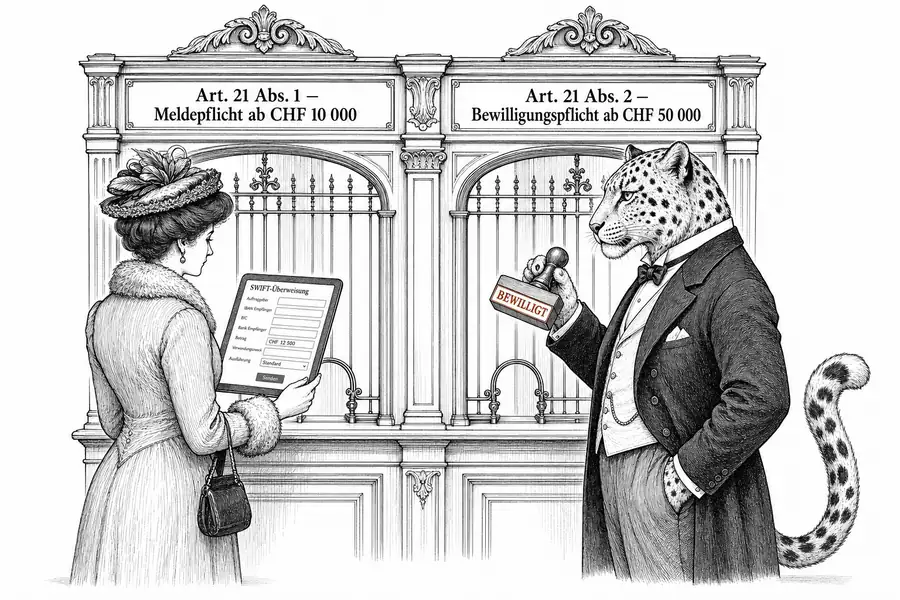
Art. 21 para. 1 SR 946.231.143.6 establishes a reporting threshold of CHF 10,000: every money transfer to or from an Iranian person or organisation above that amount must be notified in writing to SECO within five working days of execution or receipt. Above CHF 50,000, prior authorisation is required (Art. 21 para. 2 SR 946.231.143.6); incoming amounts may not be credited to the beneficiary’s account until SECO approval has been obtained (SECO guidance note on Art. 21, as at 12 December 2025). Art. 21 para. 4 additionally captures structuring through third parties; repayment of an export credit in multiple instalments is expressly treated as a single connected transaction. This threshold architecture mirrors the structure Switzerland introduced in the Russia Ordinance (SR 946.231.176.72); the same monetary lines have been transposed to a different geography.
Art. 22 prohibits Swiss financial intermediaries from opening accounts with Iranian banks or establishing correspondent banking relationships. The provision formed part of the pre-JCPOA sanctions regime and has been reactivated by the comprehensive revision.
Art. 9 prohibits the purchase and import of Iranian crude oil and its derivatives; Art. 14 blocks loans and credit facilities to companies in the oil, arms and petrochemical sectors. Both provisions were suspended during the JCPOA relaxations between 2016 and 2025 and have now been reactivated.
What banks must now do differently in practice
Three points for practitioners.
First: the definition of “person” in Art. 21 is both narrower and broader than most KYC filters anticipate. It covers only those whose place of residence or domicile is in Iran, measured by their habitual centre of life. An Iranian national resident in Zurich falls outside its scope. Subsidiary structures outside Iran that are under the direct or indirect control of Iranian persons or authorities, however, fall within it. Any institution that has filtered KYC processes exclusively by nationality since 2016 has been applying the wrong screen.
Second: the transitional period for contracts concluded before 12 December 2025 expired on 13 March 2026. Any institution continuing to hold open Iran positions is doing so under the new regime; retrospective notifications and authorisation applications are unavoidable.
Third: the humanitarian exceptions are explicit but granular. Foodstuffs, healthcare services, pharmaceuticals and medical equipment are exempt from authorisation under Art. 17 and Art. 18, but remain subject to the notification requirement. UN bodies, international organisations and NGOs holding observer status in the UN General Assembly are fully exempt. Clean payments to fund unsanctioned bank accounts require no authorisation.
What is known, what is not, and which event will settle it
The architecture is established. Switzerland has, for the first time since adopting the Russia measures in 2022, enacted a sanctions package against a third country that matches EU coverage; the operational convergence described in our analysis of the 19th EU package now extends to Iran. The thresholds and the transitional period are also established.
What remains unknown is SECO’s practice under Art. 21 para. 4. The guidance note distinguishes between a permissible bulk booking and a “deliberate structuring”, without defining the boundary. Salary payments by a company to multiple employees fall expressly in the first category; repayment of an export credit in instalments in the second. Between those two poles lies the concrete risk for mid-sized banks and trustees whose client base cannot rule out Iran exposure.
The event that will practically settle this aggregation line is the first published SECO ruling or official bulletin on an Art. 21 structuring case. Until then, the CHF 10,000 threshold remains a hard limit without interpretive guidance. Any institution still operating under the old Iran playbook has been out of compliance since 13 March 2026 and is likely accumulating findings for the next FINMA on-site inspection.