
Venezuela Ordinance of 13 January 2026: The SECO List That Falls Through the Screening
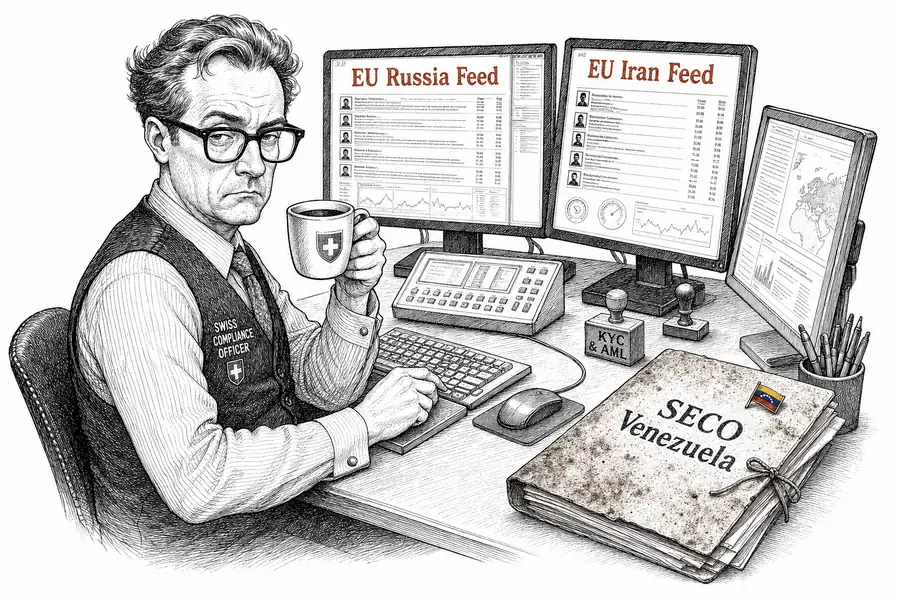
The revised Venezuela Ordinance updates the blocking lists under an autonomous Swiss mandate. Institutions that have calibrated their screening to EU feeds for Russia and Iran will not catch the SECO designations.
Dr. iur. Servatius von Tatzenberg
The Ordinance on Measures against Venezuela (SR 946.231.178.5) received updated annexes on 13 January 2026 — without most Swiss compliance functions even having it in their screening. The gap is structural, not individual. Institutions that have calibrated their screening engine to EU feeds for Russia and Iran will not catch the SECO designations for Venezuela.
A preliminary remark is warranted. Switzerland adopts the EU sanctions regime against Russia in large part autonomously, which has led many screening providers to the pragmatic shortcut of feeding their Swiss lists from EU sources. This works for Russia because the Bundesrat tracks EU listings (the 19th package — see our analysis of 18 May). For Venezuela, the logic breaks down. The SECO list is an independent inventory under Art. 2 EmbG (SR 946.231), not derived from Regulation (EU) 2017/2063. Institutions that substitute the SECO source with EU feeds do not have full Swiss compliance coverage.
The revision itself is straightforward. It updates the annex with blocking lists of natural and legal persons and reaffirms the prohibition on circumvention transactions. The operational obligations remain unchanged: asset freeze and prohibition on making funds available, together with the duty to report to SECO upon a hit or reasonable grounds for suspicion (Art. 6 EmbG). What is new is the persons against whom those obligations apply — not the obligations themselves.
Three consequences for the coming week.
First: financial intermediaries should obtain explicit confirmation from their screening provider as to which source is used for the Swiss Venezuela list — the SECO sanctions list itself or an EU surrogate. If the answer is an EU surrogate, that is a documentable deficiency in the control framework.
Second: a re-run of the existing client base against the 13 January 2026 version is mandatory. Spot-checking new additions is not enough. The annexes apply from the date of entry into force — including existing positions. The freeze obligation arises from that moment, not from the next KYC refresh.
Third: correspondent relationships and trade finance exposures involving Venezuelan state-owned entities should be reviewed. Positions vis-à-vis subsidiaries of listed entities may fall within the asset-freeze logic where a control or ownership link exists. This mechanism mirrors Art. 8(4) of Regulation (EU) 2017/2063 and is interpreted by Swiss enforcement in a comparable manner.
The open question is one of reach. Whether SECO applies the asset-freeze logic against conduit entities in third-country jurisdictions (Panama, Dubai, Turkey) with the same rigour as in Russia enforcement will become clear from the first published ruling of 2026.