
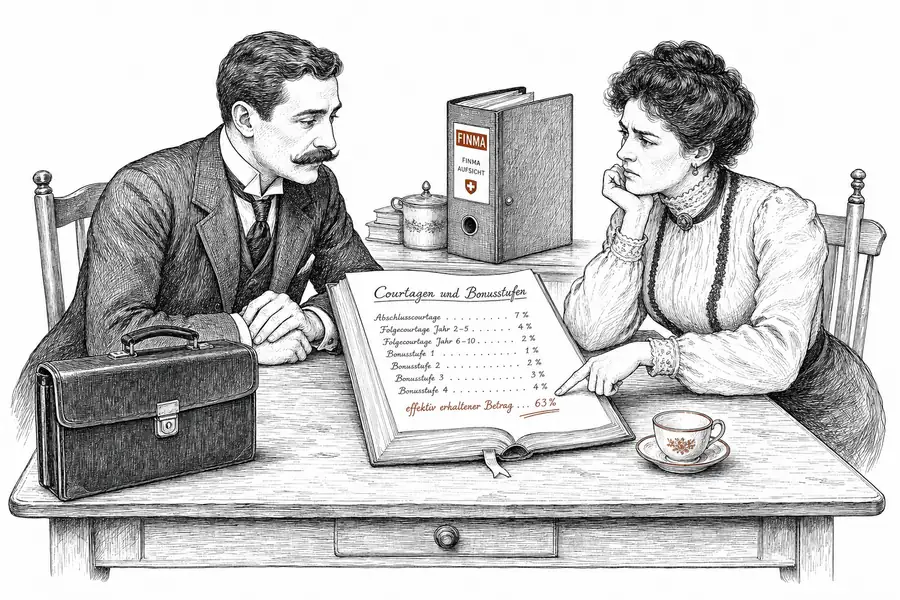
When the Client Asks for the Amount, Art. 45b Para. 3 VAG Opens Your Commission Schedule
FINMA locates the remaining intermediary abuses in qualification, registration, and remuneration, and has ordered remedial client consultations at insurance companies. Art. 45b para. 3 VAG explains the leap: the facts that must be disclosed sit in the insurer's remuneration schedule, not with the broker.
Casimir von Firn, MLaw
On 17 June 2026, at its intermediary symposium, FINMA took stock of two and a half years under the revised Insurance Supervision Act (VAG): the abuses that remain range from bad advice to forged training credentials, and at their core sit the independent intermediary’s qualifications, registration, and remuneration. FINMA has ordered remedial client consultations at several insurance companies, covering thousands of customers. The next step follows logically: what the intermediary must disclose under Art. 45b para. 3 VAG isn’t something they hold themselves — it sits in the remuneration schedule of the commission agreement that the insurer drafted.
The numbers put the market in context. Roughly 12,000 independent insurance intermediaries are listed in the FINMA register; since 1 January 2024, more than 7,000 registrations have been added and around 3,000 have dropped off. FINMA estimates that those operating without authorisation make up roughly ten percent of all market participants. We covered these unregistered outsiders on 28 June; this piece is about the registered ones, and about the paper that governs their pay.
Three Tiers, None of Them Held by the Intermediary
Art. 45b VAG tiers the disclosure obligation, and each tier cuts deeper. Para. 1 lets an independent intermediary accept payments from insurers only if they have expressly told the policyholder about them. Para. 3, first sentence, requires disclosure of “the nature and extent of the payment” before the service is rendered or the contract concluded. Where the amount isn’t fixed in advance, the second sentence requires disclosure of “the calculation parameters and the ranges.” The third sentence is the hard part: “On request, insurance intermediaries shall disclose the amounts actually received.” Under para. 4, payment covers commissions, fees, brokerage, rebates, or other pecuniary benefits. A volume bonus counts just as much as the base commission.
The Clause That Ties the Distribution Partner’s Hands
None of the three tiers can be filled from the intermediary’s own knowledge. The nature and extent of the payment sit in the insurer’s commission schedule. The calculation parameters are the insurer’s bonus formula: volume tiers, growth targets, lapse ratios, surcharges for portfolio maintenance. The intermediary does know the amounts actually received, but whether they may state them is decided by the confidentiality clause in the distribution agreement. If that clause covers remuneration terms, the distribution partner is left choosing between breaching the contract and breaching the law. The same problem arises one article earlier: Art. 45a VAG requires the intermediary to put organisational safeguards in place against conflicts of interest, and an incentive designed by someone else is not something organisational measures can remove. Both duties are addressed to the intermediary. The clause that ties their hands was drafted by the insurer.
Why the Bill Lands on the Insurer’s Desk
Responsibility lands on the insurer through two other provisions. Servatius von Tatzenberg explained on 19 June that Art. 44 para. 2 VAG bars cooperation with unregistered intermediaries, and that the fit-and-proper requirement (Gewähr für eine einwandfreie Geschäftstätigkeit) under Art. 14 VAG reaches all the way up to the board of directors. On top of that comes abuse supervision. Art. 46 para. 1 let. f VAG instructs FINMA to protect policyholders against abuses committed by insurance companies and intermediaries alike; Art. 117 para. 1 of the Insurance Supervision Ordinance (AVO) defines abuse as a disadvantage that recurs or could affect a broad group of people. A remuneration grid meets that test by design, because it applies across the entire book. That is why the remedy is remedial consultations for thousands of policies, not a fine against one broker. FINMA director Stefan Walter puts a number on the scale: “Thousands of insurance customers are affected every year.” Remedial consultations cost cover reviews, unwinding, and staff time — and it is a supervisory order against the insurer that no indemnification clause can change.
Law firms are reading June differently. MME sums up the message as a shift from rolling out new processes to actually complying with them in day-to-day distribution, addressed to the intermediary; trade press billed the event as an offer of dialogue. Both are true, and both fall short. Retrofitting the three clauses we described on 19 June controls the intermediary’s conduct — the right to audit, termination on loss of registration, indemnification. None of them touches the incentive that produces the conduct in the first place.
Three Tasks for This Week
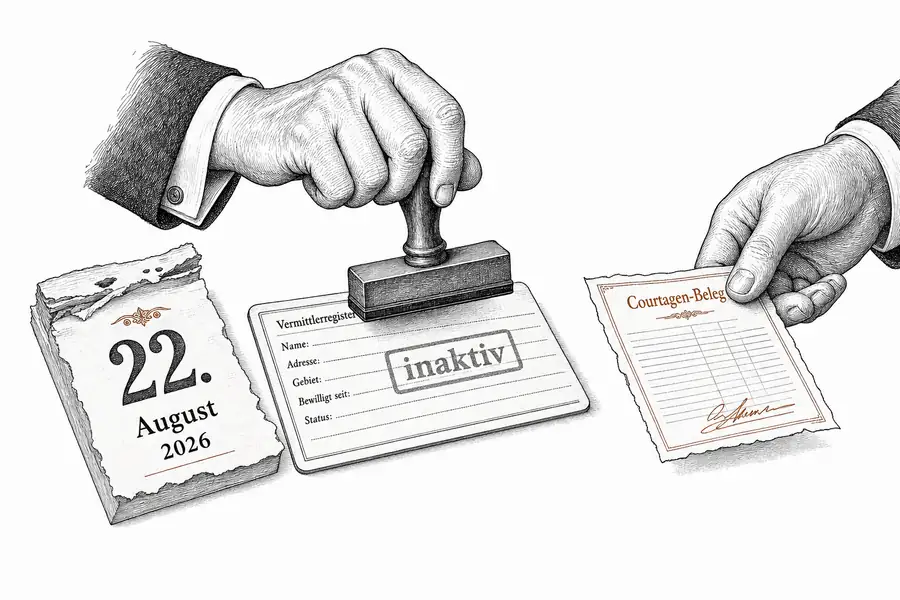
First, open the remuneration schedule and check every component against whether it can actually be expressed in terms of nature, extent, calculation parameters, and range. A bonus formula that can’t be reduced to a single customer-facing page isn’t disclosable under Art. 45b para. 3 VAG. Second, add an express carve-out to the confidentiality clause that clears the way for disclosure under Art. 45b VAG, including the amounts actually received, and set out who answers when the customer asks the insurer directly. Third, mark 22 August 2026 on the calendar: by then, a portion of registered intermediaries must show proof of their first recertification, and if they don’t, the industry association is required to report it to FINMA under Art. 190a para. 3 AVO. That can cost them their registration, and any commission paid out after that would likely breach Art. 44 para. 2 VAG. A quarterly register check catches this too late.
The Two Events That Will Settle It
Three things are known: FINMA’s list of abuses, the number of registered intermediaries, and the tool supervision reaches for. What’s open is whether FINMA will treat the insurer’s own remuneration model as abuse under Art. 117 AVO in its own right, or continue to use it merely as evidence against the intermediary. The answer will come from the deregistrations after 22 August 2026, and from the first enforcement action that names not a broker’s conduct, but an insurer’s bonus tier.